
Could Life Abroad Actually Work for You?
Most people rule out living abroad using the wrong numbers. Here is how to check yours, one part of your life at a time.
Before you pick a country, find out what is realistic for you
Living abroad can sound like a dream or a gamble. The honest answer depends on your home, your income, your skills, your family and your responsibilities, and most people never look at those clearly. This guide does, one area at a time.
Get your personalized starting point
Answer a few questions about your income, savings, property, responsibilities and what you want from daily life.
In about three minutes, the Relocation Reality Check will show what may already be working in your favor and what deserves more attention.
Take the free Relocation Reality Check →
Tap the part that sounds most like you to jump straight to it
Each part stands on its own, so you can come back to the others later. Read it all and it takes about 30 minutes. Or tap the part that sounds like you and start there.

If you've watched Passport Heavy for a while, you've probably said one of these out loud. Maybe to your screen. Maybe to yourself.
"That worked for them, but it wouldn't work for me."
"I don't have enough money."
"My income can't move."
"I still have a mortgage."
"My family would never agree."
"I have too many responsibilities."
"I wouldn't know where to begin."
Some of those concerns are real. A few of them might be the reason living abroad isn't right for you, at least not yet. That's a perfectly good outcome.
But here's something we see over and over. People judge their options using only the prices, the rules and the assumptions of the place they live right now. They look at their mortgage and see debt, not the value they've built. They look at their paycheck and compare it to American prices only. They assume a move has to be permanent, all at once, and perfect on the first try.

This guide walks through seven areas, one at a time. In each one, you'll see what might already be working in your favor, what deserves more attention, and what to look into next. It isn't here to convince you to move. It's here to help you look at the possibility honestly, with better information than you had before.

Part 1: Your home may contain more freedom than you realize
Who this is for: You own a home, you still have a mortgage, and that unfinished mortgage feels like a chain keeping you where you are.
In 30 seconds
What you owe and what you own are two different numbers.
Equity can mean selling, downsizing, renting it out, or keeping the house while you test.
The same $300,000 lasts about twice as long in a city like Da Nang.
Most homeowners can tell you their mortgage balance to the dollar. Ask them how much of the house they actually own, and they have to think about it.
That’s not an accident. The mortgage shows up every month as a bill. The value you’ve built doesn’t show up anywhere unless you go looking for it.

What equity actually is
Equity is what your home would likely sell for, minus what you still owe on it.
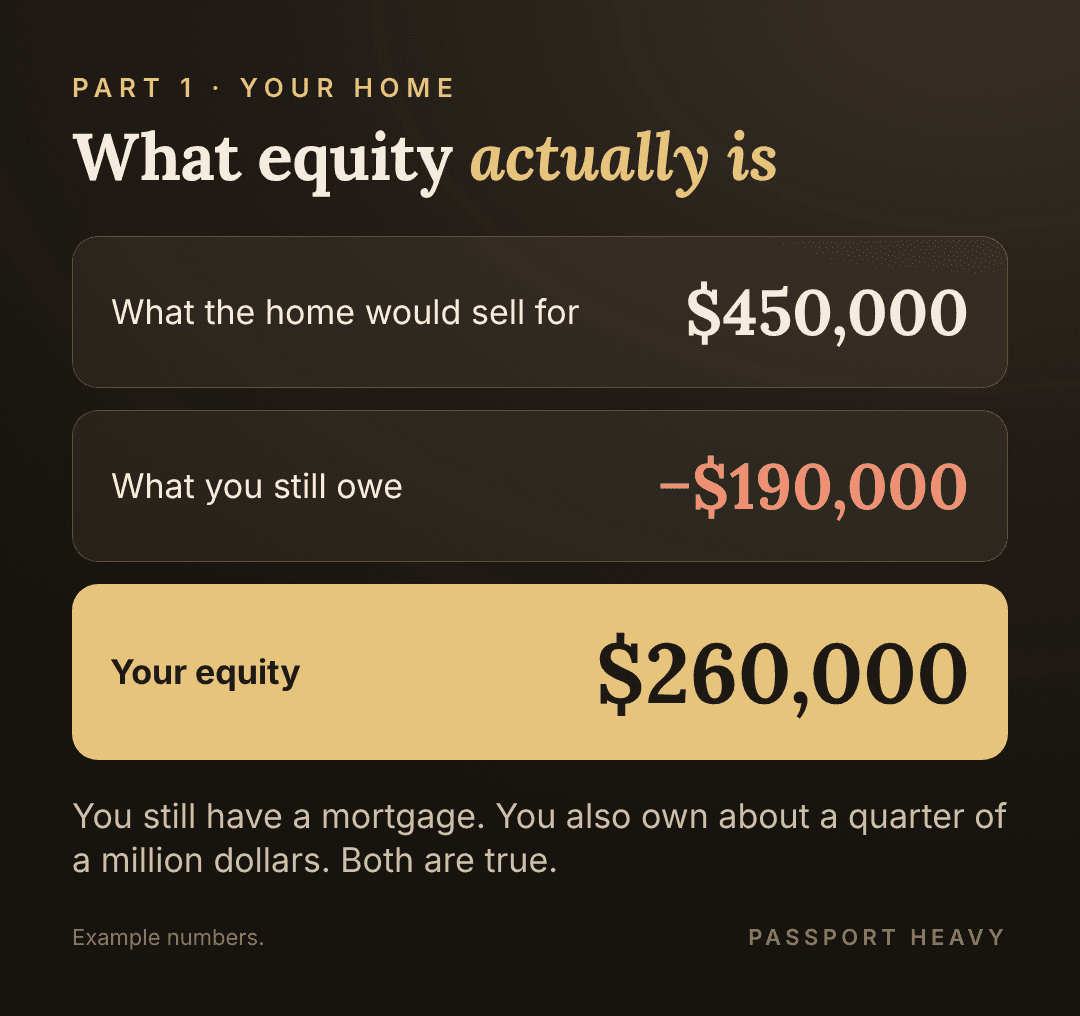
In that example, you still have a mortgage. You also own about a quarter of a million dollars of value. Both are true at the same time.
You wouldn’t be unusual. In the second quarter of 2026, American homeowners with a mortgage held a record $18 trillion in equity, and the average one had about $212,000 they could borrow against while still keeping a cushion in the house.
Why people overlook it
The debt is loud, the value is quiet. You feel the payment every month. You never feel the equity unless you sell or borrow.
It doesn’t feel spendable. And honestly, it isn’t, not until you do something with the house.
We compare it to where we live. $260,000 doesn’t buy much of a new home in most American cities, so it feels small. Somewhere with lower day-to-day costs, the same amount can do a lot more.
The four main ways equity can create options
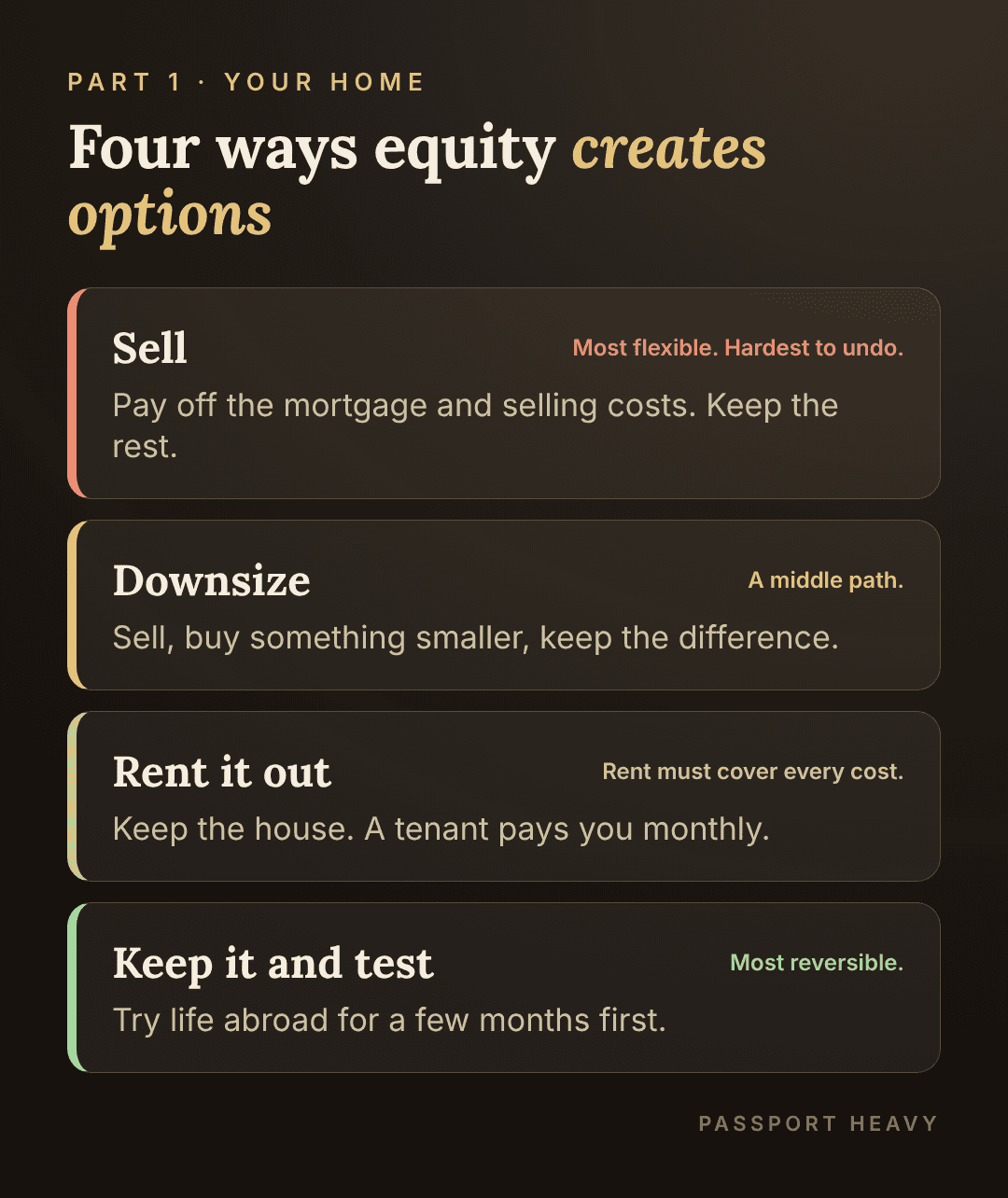
Renting only works if the rent covers the mortgage, taxes, insurance, repairs, management and empty months. (Jubril sublet his Miami apartment for three months to test. See Part 4.)
The same equity, very different flexibility
Here’s a simple way to see it. Say you sell and walk away with $300,000 after selling costs and the mortgage payoff. How long would that cover your living costs, before any investment growth or other income?
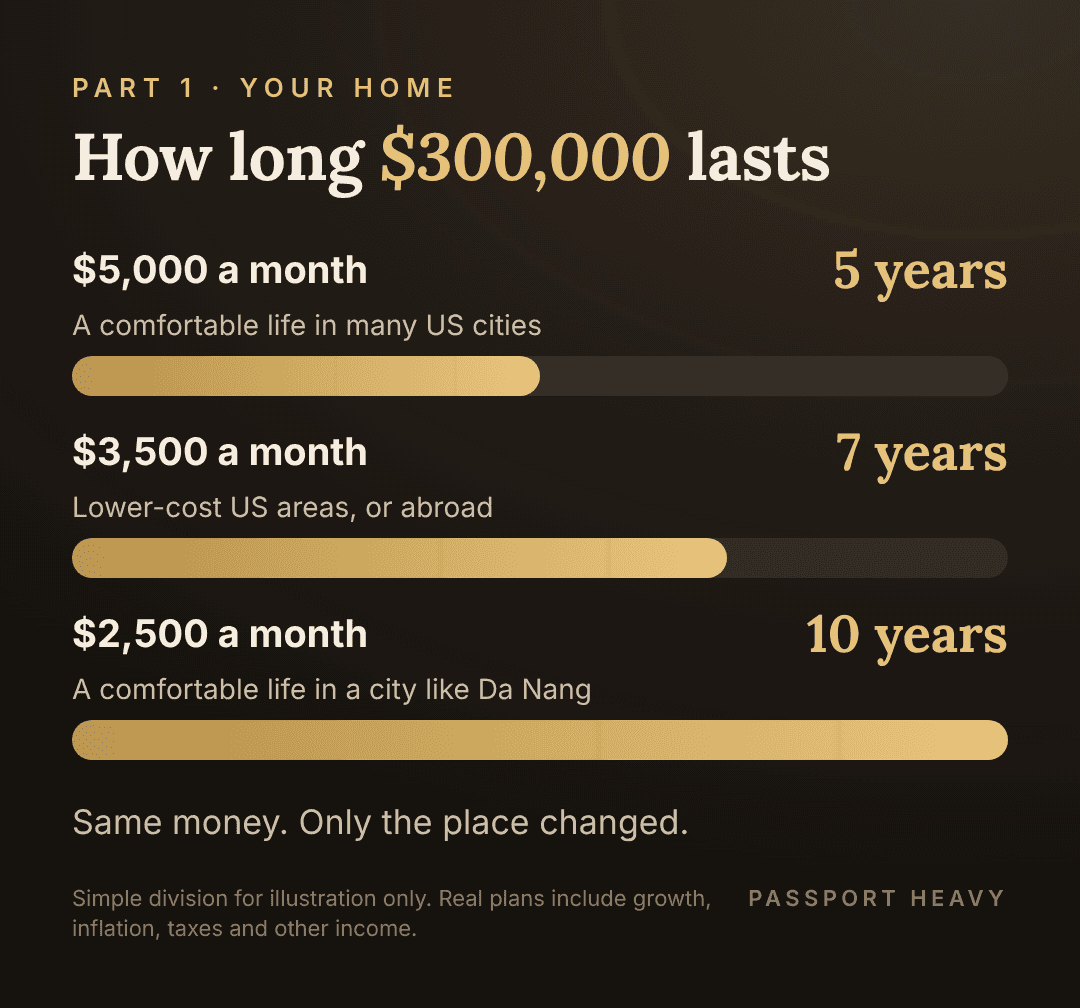
Simple division for illustration only. Real plans include investment growth, inflation, taxes, Social Security, health insurance and other income.
Nothing about the money changed between those rows. Only the place changed.
What equity is not
Equity is not cash in your pocket. Before you count on it:
Selling costs money. Agent commissions averaged about 5.5% to 5.7% in 2026, plus closing costs.
Taxes can apply. In the US, a single person can usually keep up to $250,000 of profit on a main home tax-free ($500,000 for married couples), if they owned and lived in it for 2 of the last 5 years. Profit above that can be taxed.
Renting isn’t free money. Maintenance, insurance, property managers and months without a tenant all come out of the rent.
Borrowing has a cost. A home equity loan or line of credit lets you keep the house, but you pay interest every month on what you take.
Get professional advice. A tax professional and a financial planner can show you what you’d really keep.
Selling is never automatically the right answer. For some people it’s the key that unlocks everything. For others, keeping the house is the smarter move. The point is to know what you have.
Want the full math? Our upcoming post on home equity will walk one homeowner through selling, renting and borrowing, with every number shown.
A real example: Debbie Welsch
Business Insider’s series “The Pay Check” featured Debbie Welsch, and her story shows this shift better than any example we could invent. All credit to Business Insider and to Debbie for sharing her real numbers.
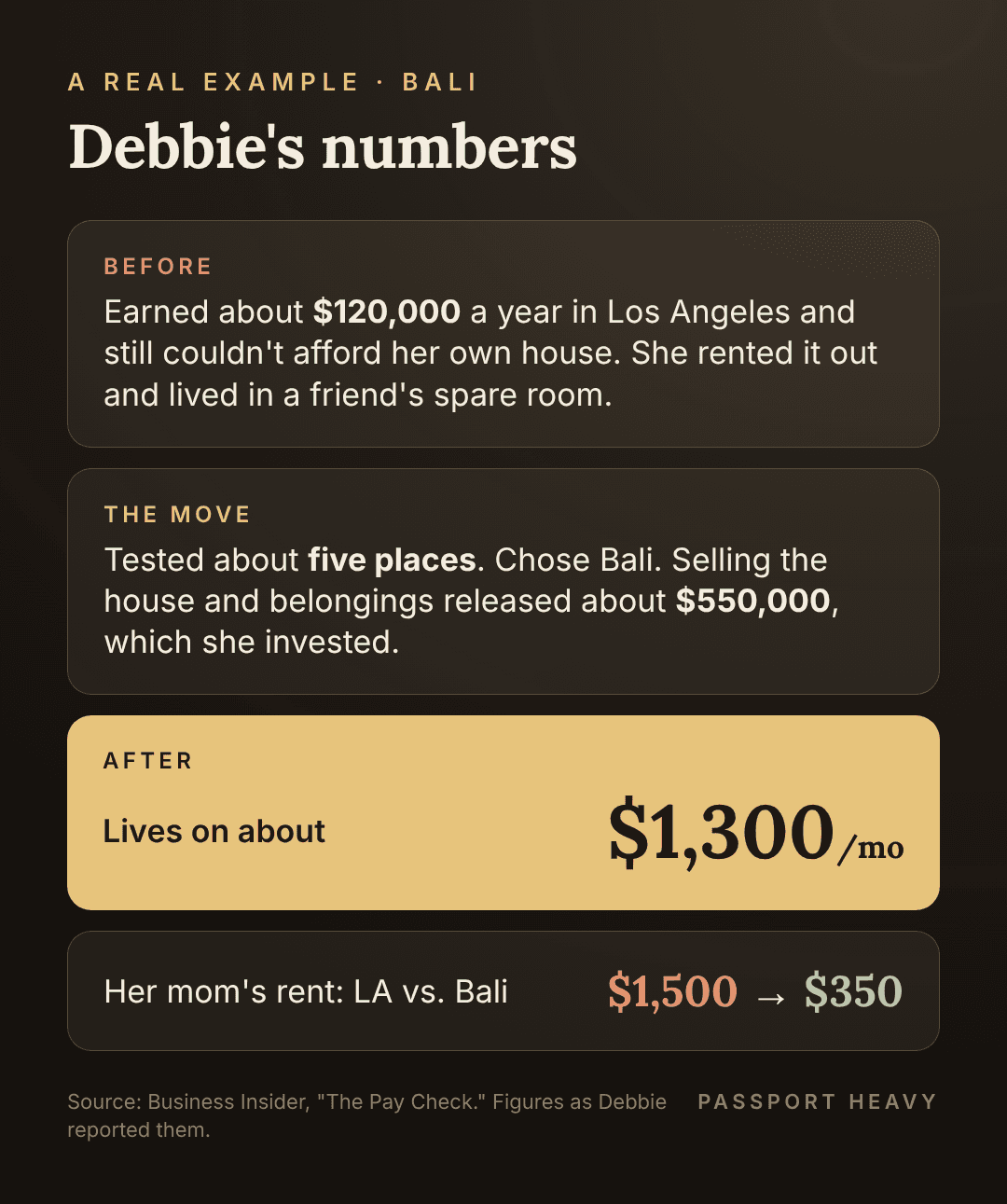
“Money is the first thing I’d think of when I wake up, and money’s the last thing I’d think of when I go to sleep.” Today, she says, “It’s not like that anymore.”
Debbie is also clear that she wouldn’t sell everything and move without first getting to know the culture and what ordinary daily life is really like. That’s why she scouted first.
Her situation won’t match yours. You may not have $550,000 of equity, you may not want Bali, and you may have people and responsibilities she doesn’t. The lesson isn’t “sell your house.” It’s this: changing her location changed what her existing assets could provide.
Watch Debbie’s full story on Business Insider’s YouTube channel
Takeaway: “My mortgage may still be a responsibility, but it does not necessarily mean I have no financial options.”
You don’t have to figure this out alone
Debbie’s numbers won’t match yours. Inside our private community, members who sold, rented out or kept their homes share what they’d do differently, and you can bring your own numbers to a property and investing session.
See inside the private community →
Up next: Your home is one lever. Next, what your income can actually buy somewhere else. Go to Part 2 →
Part 2: Your income may be worth more somewhere else
Who this is for: You have income, from a job, remote work, a pension, Social Security or investments, and you still feel like you can’t afford the life you want.
In 30 seconds
Your income is only half the equation. Where you spend it is the other half.
A typical retiree’s $2,750 comes up $1,200 short in Miami and leaves over $1,000 spare in Da Nang.
Affording a country and being allowed to live there are two separate questions.
A $2,500 monthly income means one thing in San Diego and something completely different in Da Nang, Athens or Valencia. The number on the check is the same. What it buys isn’t.
That idea has a name: purchasing power. It just means how much life your money can buy where you spend it.

The $20 bill story
Picture a $20 bill. In one store, it buys you a sandwich and a drink. Walk into a different store across town, and the same $20 buys lunch for two with dessert.
The bill didn’t change. It’s the same paper, the same $20. Only the store changed.
Your Social Security check, your pension and your savings work exactly the same way. The amount stays the same wherever you go. The “store” you spend it in is what decides how far it goes.

Meet Carol, an example retiree
Carol is made up, but her numbers are the national typical numbers:
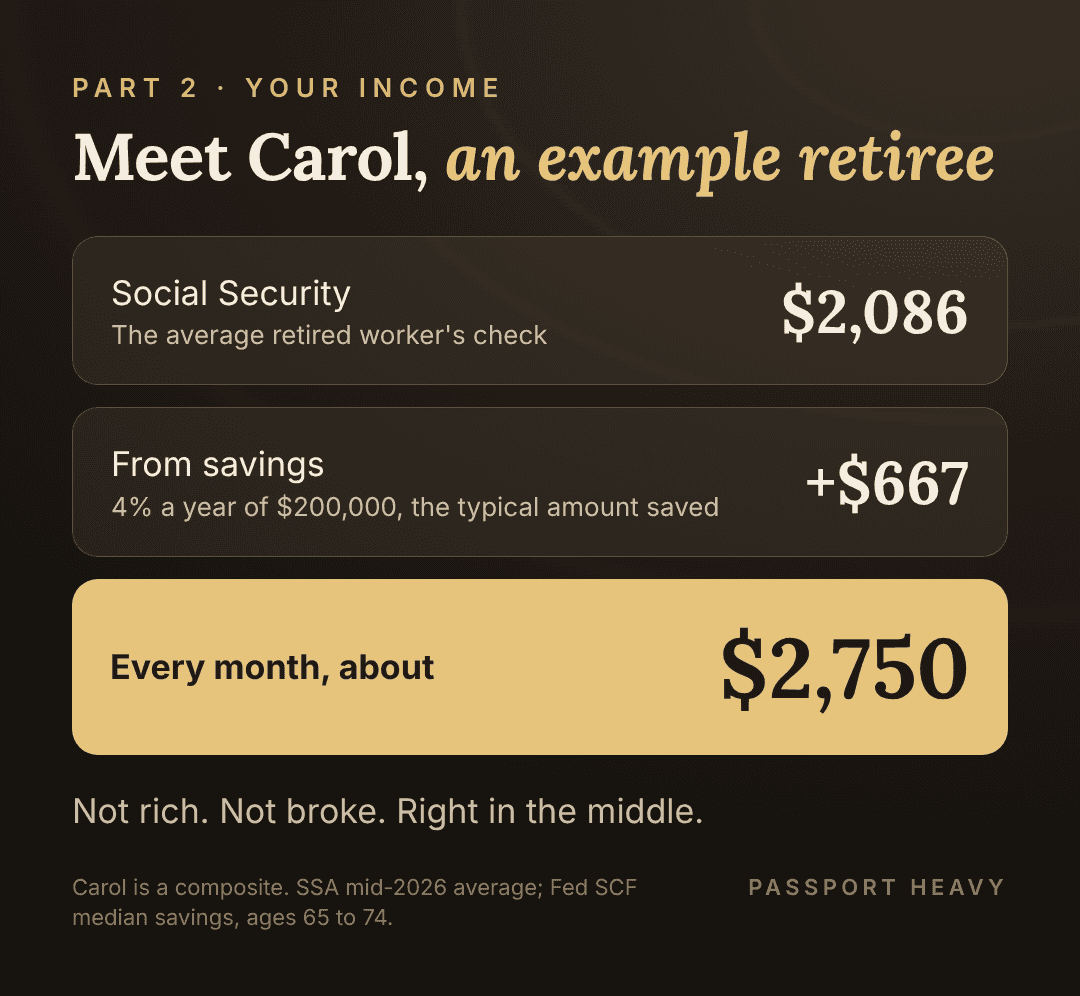
Carol isn’t rich and she isn’t broke. She’s right in the middle. Now let’s see what her $2,750 does in four cities (two budgets in Da Nang).
Same check, four cities
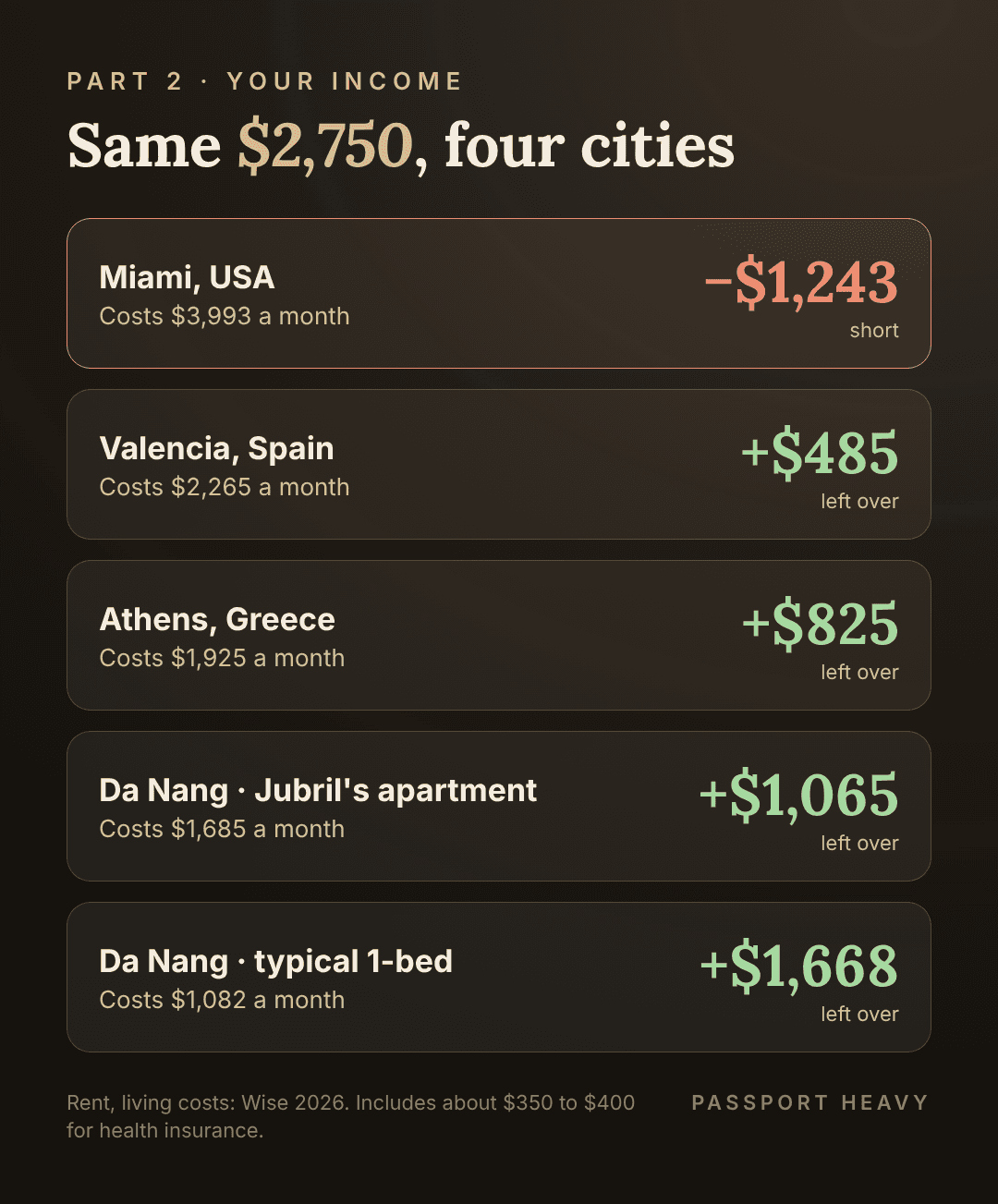
Rent is a typical 1-bedroom outside the city center, and “everything else” is a single person’s typical monthly costs without rent, both from Wise’s 2026 cost-of-living data (Athens converted from pounds at Oct 23, 2026 rates). Jubril’s apartment is his real rent. Health insurance is our estimate: in Miami, Medicare Part B ($202.90 a month in 2026) plus a supplement and drug plan; abroad, a private international plan for someone in their 60s. Your numbers will differ.
In Miami, Carol comes up about $1,200 short every month. She has to drain her savings faster, cut back hard, or go back to work. In Valencia, Athens or Da Nang, the exact same income covers her life and leaves money over, from about $500 to more than $1,600 a month. That extra is a cushion for emergencies, travel home to see family, or simply not worrying.
And notice: Carol doesn’t have to pick the bare-minimum option to make it work. Even in Jubril’s modern riverside apartment in Da Nang, she has over $1,000 left each month.

Carol is made up. Genise isn’t.

Genise spent her career in corrections. After she retired, she worked part-time for Delta for about eight years, and flying internationally changed how she saw the rest of the world. Two years ago, she moved to Bangkok. Her daughter lives there too, and another daughter is on her way to join them.
She lives mainly off her pension. She doesn’t touch her Social Security or her savings, and she still has money left over. Her two-bedroom apartment costs about $900 a month. Back home, she says, she could have covered the basics, but not the extras that are now part of her normal week: massages, private Pilates and pickleball lessons.
“Here, you can do all that and have change.”
She didn’t pick Bangkok off a list. In every country she considered, she looked for the local expat community first, and Bangkok’s was the one that felt like home. Her advice for anyone still on the fence: “I would have definitely done it sooner.”
Before Carol packs: can she actually live there?
Here’s the part most “cheapest places to retire” lists leave out. Affording a place and being allowed to live there are two different questions.
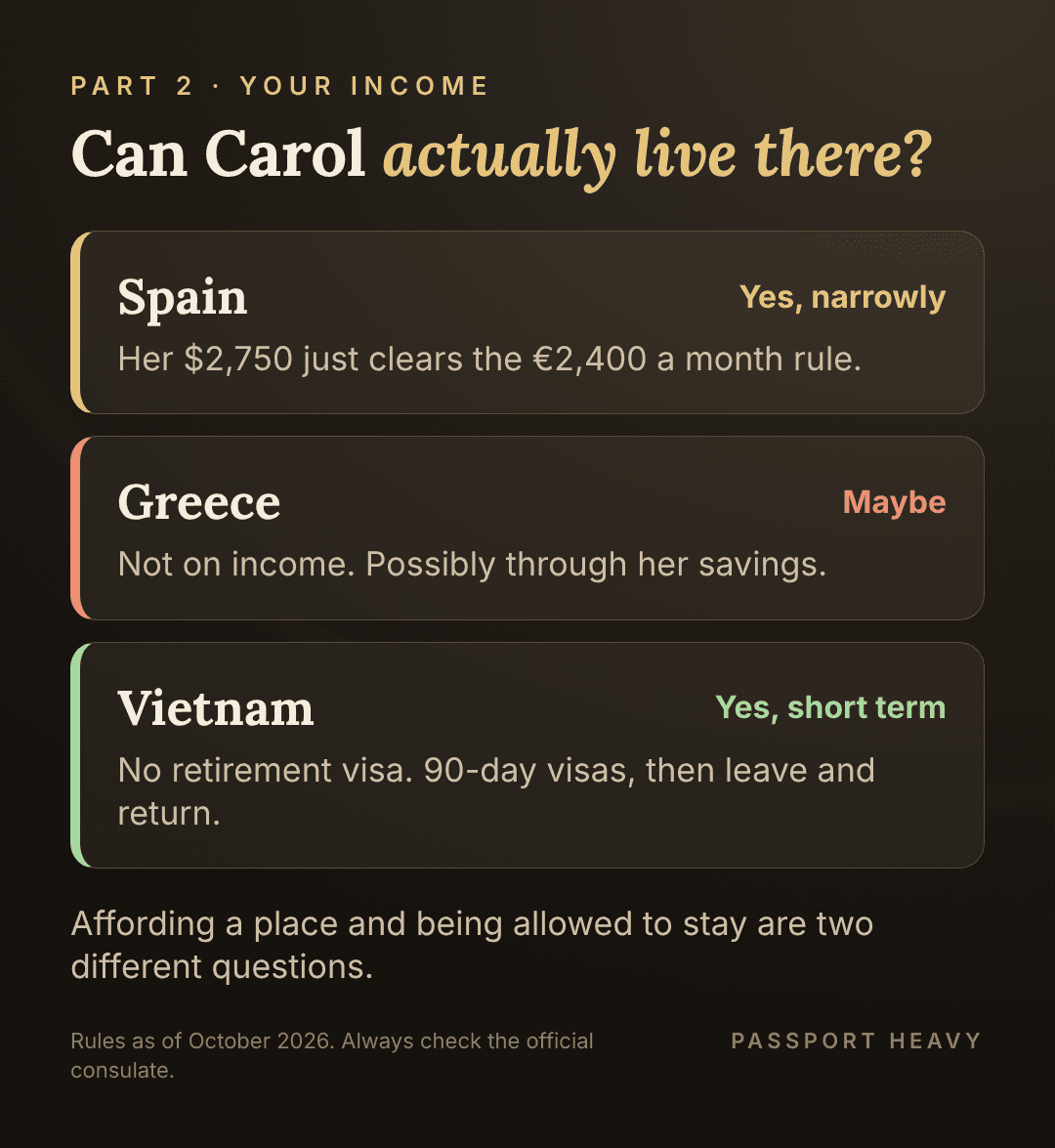
Visa amounts as of October 2026, converted at €1 = $1.12. These rules change, so always check the official consulate before you plan around one. For more countries, see the visa section in Part 7.
So the honest picture is this. Spain works for Carol, just barely. Greece may work through her savings rather than her income. Vietnam gives her the most room in her budget but the least long-term legal security. There’s no perfect answer, only trade-offs, and now she can see them.
One more thing: taxes. Greece offers a flat 7% tax on foreign pension income for some retirees who move their tax residence there. Spain taxes residents on worldwide income, with special rules for US Social Security under the US-Spain tax treaty. And US citizens file US taxes wherever they live. Talk to a cross-border tax professional before you choose.
Now do your own math
Grab a pen. This takes two minutes.
1. Your monthly Social Security (find it at ssa.gov/myaccount): $________
2. Your pension, if you have one: $________
3. Your savings x 0.04, divided by 12 (a common rule of thumb for a safe monthly withdrawal): $________
4. Any other income (rental, part-time work): $________
Your monthly income (add 1 to 4): $________
Now compare it to the monthly costs in the five-cities chart above, or to any city you’re curious about. If your income is above that cost, that city could work on paper. Then check the visa rule. If it’s below, that’s useful too: it tells you which places to cross off, or how much more income you’d need.
Jubril’s real prices in Da Nang
Averages are helpful, but nothing beats real receipts. Here’s what everyday life actually costs Jubril in Da Nang in 2026:
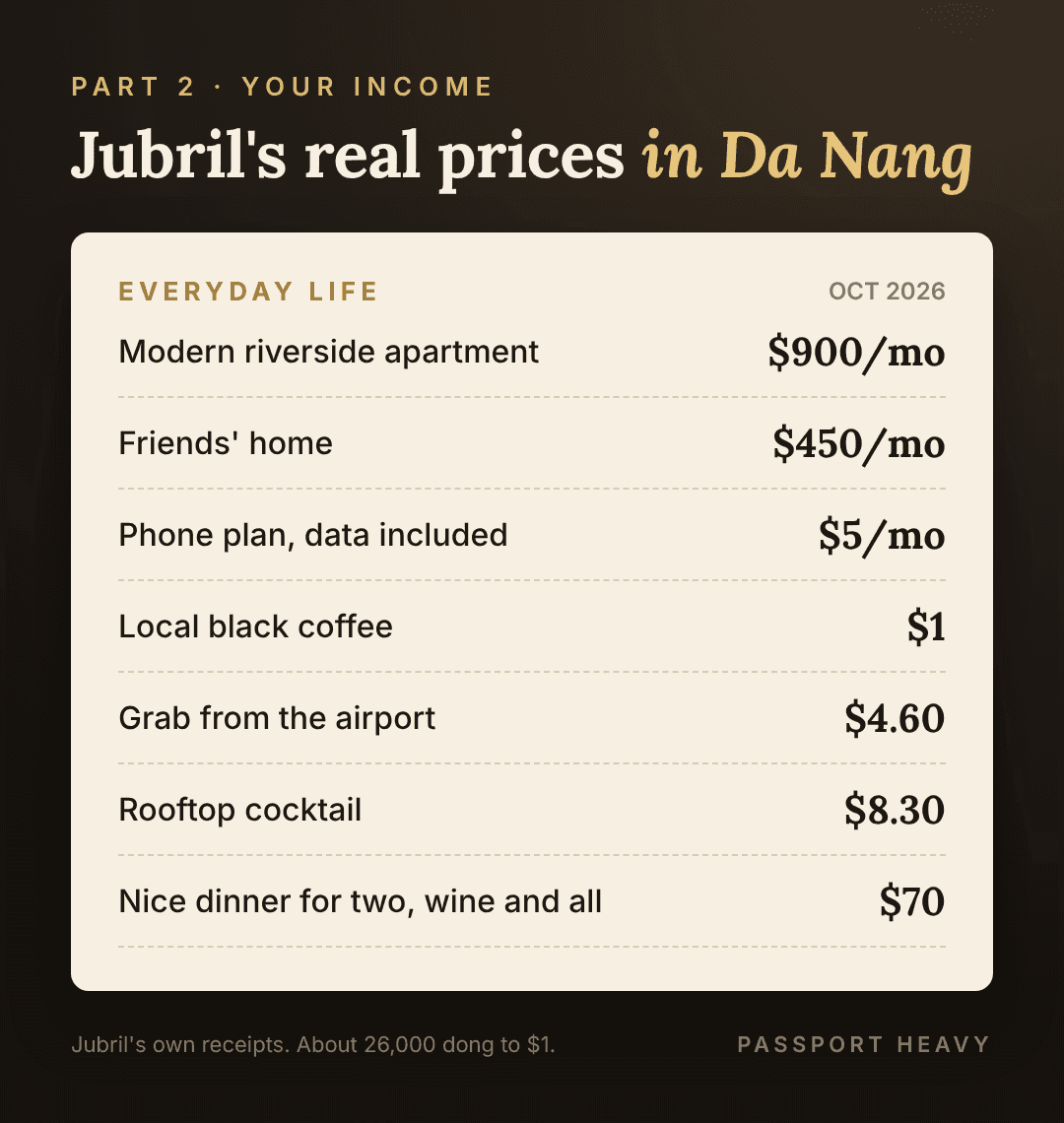

Prices converted at about 26,000 Vietnamese dong to $1, October 2026.
We use Da Nang a lot because it’s where we filmed and where Jubril lives. It’s one example to show how purchasing power works, not a recommendation that everyone should move there.
The five big costs to compare
When you compare any destination to home, look at these five, in this order:
Housing. Usually the biggest swing. Compare the kind of place you’d actually want to live in, not the cheapest listing you can find.
Food. Groceries and eating out. Local food is usually far less expensive than imported Western brands.
Getting around. Many people abroad don’t need a car at all. That can remove a car payment, insurance and gas in one move.
Utilities and phone. Electricity can be expensive in hot places if you run air conditioning all day.
Health care. Often much less expensive per visit, but you’ll likely need private international insurance. In the US, the average employer plan for one person cost about $9,325 a year in 2025, and that’s the version where your boss pays most of it.
Local life vs. expat bubble
Two people can live in the same city on very different budgets. One shops at local markets, eats where locals eat and rents in a neighborhood with real families. The other lives in an expat high-rise, eats imported food and spends every night where tourists go. Both are valid. They just cost very different amounts.

Be honest with yourself about which life you’d really want. Then price that life, not the fantasy version or the bare-minimum version.

A word on perspective
What feels inexpensive to you is a real price to the people who live there. In Vietnam, the average worker earned about $354 a month in Q3 2026. That $70 dinner is about a fifth of a local monthly paycheck. You’re a guest in someone’s home city. Be conscious of that, and never call it “cheap” at the table.

What purchasing power doesn’t solve
Affordability isn’t a visa. Being able to afford a country doesn’t mean you’re allowed to live there long term. Each country has its own rules.
It isn’t a personality fit. Heat, noise, language and pace of life matter as much as price.
Costs change. Prices rise abroad too, and exchange rates move. Build in a cushion.
Takeaway: “My income might support a very different quality of life in another location.”
Go deeper: check your numbers with people living on them
Carol is an average. You’re not. Members living in Da Nang right now, including Tiffany and Majida, share what life actually costs them, and you can bring your own budget to a live call.
Go deeper inside the community →
Up next: what if your income can’t move with you? Go to Part 3 →

Part 3: You may already have skills that can travel
Who this is for: Your income is tied to where you live. Your job needs you in a building, a hospital, a classroom or a job site, and you can’t picture what else you’d do.
In 30 seconds
You may not need a new career, just a way to deliver what you already do online.
Teaching English online is one of the most common first steps we see, and you don’t need to speak your students’ language.
Making less can still mean keeping more.
When people say “I don’t have any skills that work online,” what they usually mean is “I’ve never thought of what I do as something I could sell on its own.” Those are very different things.

Before we get into skills and options, meet two people who started from about as close to zero as it gets.
A real example: Ralph and Christina

Ralph and Christina are members of our private community, and they’re in our upcoming Da Nang episode, where you’ll see the home they rent there for about $450 a month.
What you might not know is how they got there. Back in the US, Ralph’s business failed. Christina was a nurse. They lost almost everything and had to start over. So they did something most people would never consider: they left everything behind and moved abroad.
They needed income that could come with them, so they both started teaching English online. Not at a school in Vietnam. Online, from home, to students in China. Christina started first, when they began living abroad. Ralph followed.
Here’s the part that stopped people in their tracks when Christina explained it on one of our community calls: neither of them speaks Chinese. Not a word of it. The lessons are in English, because English is what the students are paying to learn.
Almost everyone in the room had assumed you’d need to speak your students’ language first. You don’t. If you’re reading this, you already speak the language people are paying for. Teaching it well is a skill you build, but the hardest part, the language itself, you already have.
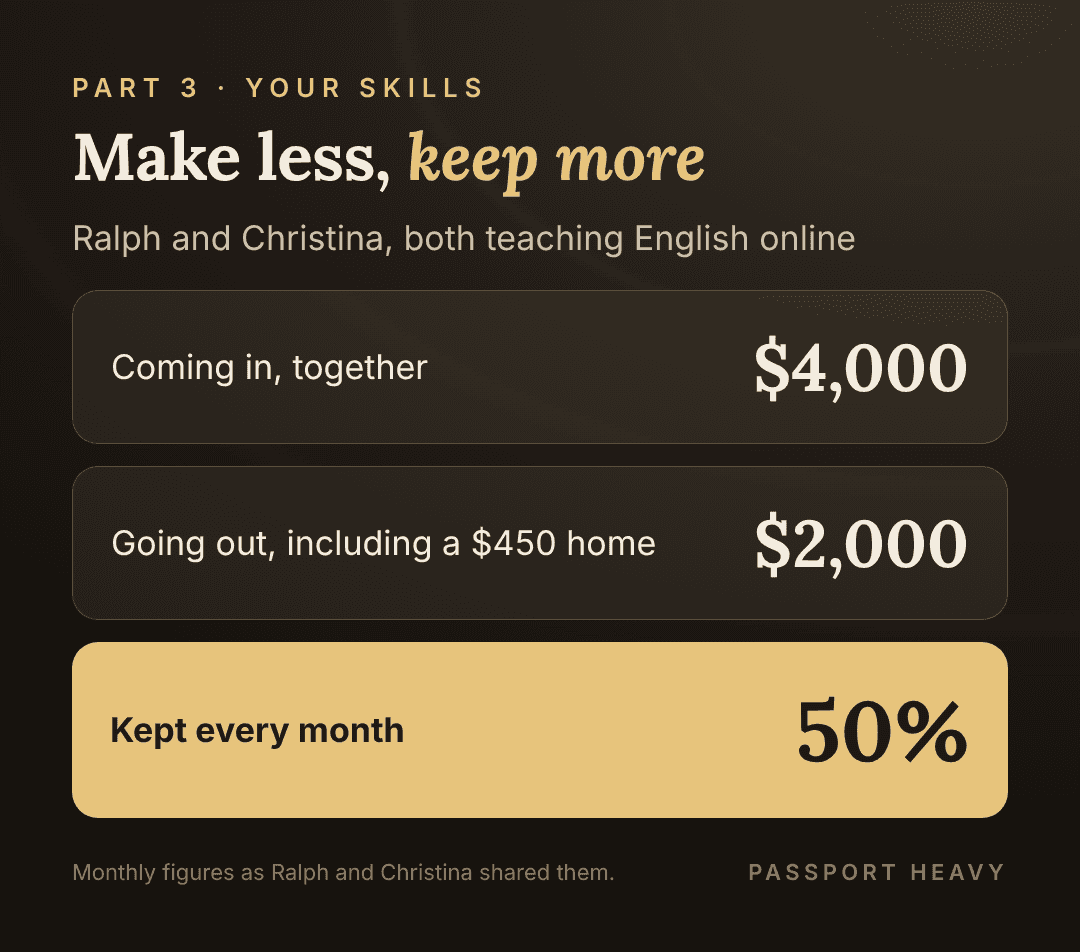
They make less than many people reading this. And they save more than most of them.
Make less, keep more: the bucket story
Imagine two buckets under a faucet.
The first bucket is big. Lots of water pours in. But there’s a giant hole in the bottom, and almost all of it drains right back out. At the end of the day, there’s a puddle.
The second bucket is smaller. Less water pours in. But the hole is tiny. At the end of the day, it’s half full.
The faucet is your income. The hole is your cost of living. What’s left in the bucket is your actual life: your savings, your freedom, your options.

The “big bucket” is an example of a typical household on a good American income, not Ralph and Christina’s old numbers.
Here’s the hard part, and it’s not the math. It’s the feeling. Going from $6,000 a month to $2,000 or $2,500 sounds like failing. A lot of people hear “I’d make less” and their brain translates it to “I’d be less.”
But the paycheck was never the score. What’s left at the end of the month is the score. Ralph and Christina keep about four times as much as the big-bucket household, and they work on their own schedule. As they found out, making less money gave them more freedom and more money left over.

Why teaching online is the most common first step
Of all the ways people earn from abroad, this is one of the most common paths we see in our community, especially for people starting over. Here’s why it works:
Huge demand. Millions of people around the world want to learn English from a native speaker.
Your students are somewhere else. You teach people in other countries over video. You’re not taking a job from a local teacher, and you don’t need to find a teaching job in the country you live in.
It goes where you go. All you need is a laptop, a quiet spot and good internet.
The bar to start is lower than most careers. For many companies, the main requirement is a bachelor’s degree in any subject.
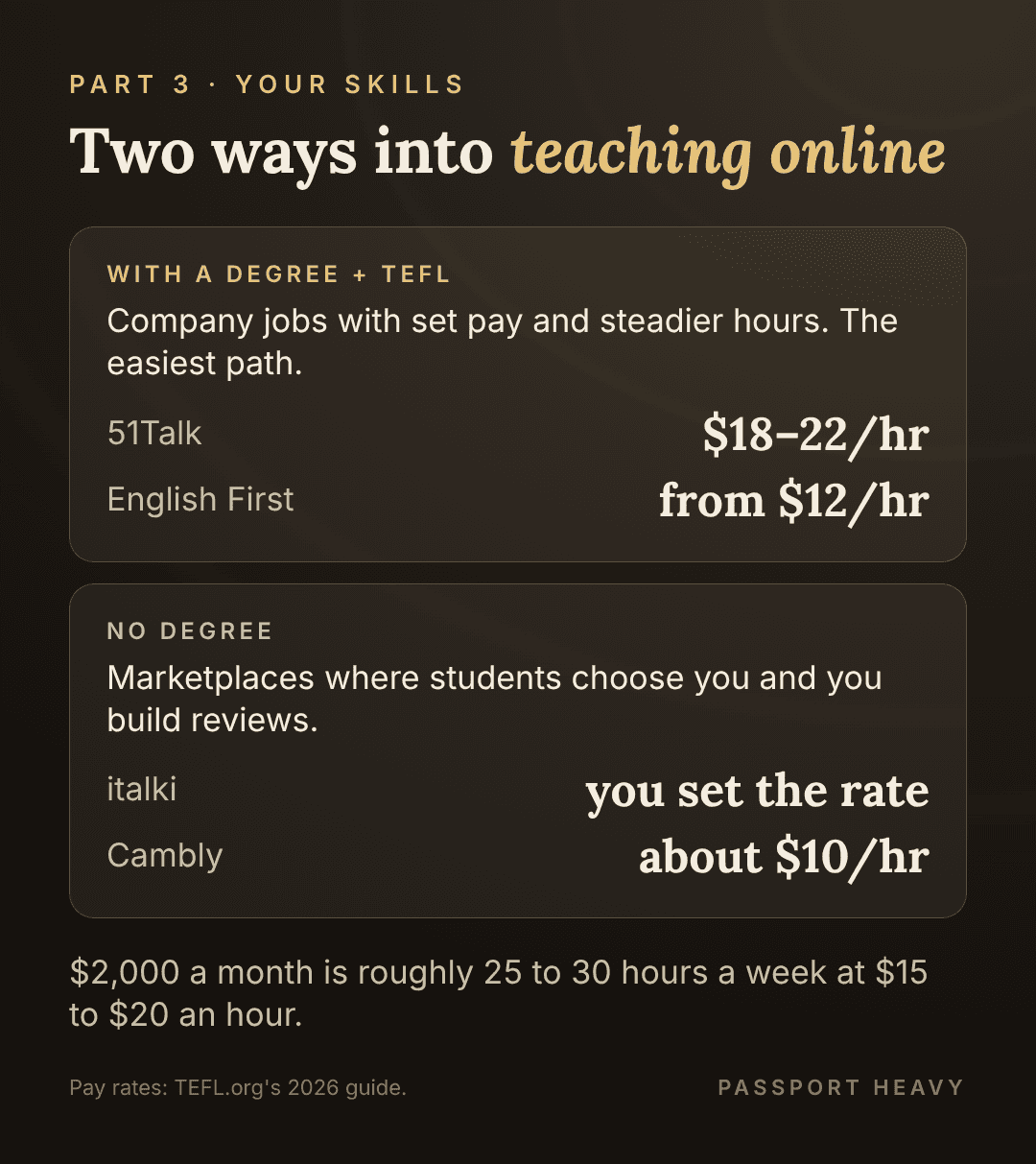
A TEFL certificate is a short course in Teaching English as a Foreign Language. Most employers and many students expect one. Pay rates from TEFL.org’s 2026 guide.
What does $2,000 a month take? At $15 to $20 an hour, that’s roughly 100 to 130 hours of teaching a month, or about 25 to 30 hours a week. Most people start at a lower rate, then raise it as reviews come in. It’s real work. It’s also work you can do in shorts with the sliding door open to a balcony.
And notice something about Christina. She was a nurse. Explaining complicated things to nervous people, with patience, is most of what a good teacher does. She didn’t throw her experience away. She moved it.
A different path: Amina
Ralph and Christina had degrees and work history to lean on. Amina’s story starts somewhere else.
She spent ten years as a flight attendant, then left for her health and her lifestyle. She hadn’t been to university. After a decade in a job that required her to be physically on a plane, constantly traveling, she didn’t feel like she had any obvious skills that could move online.
So she didn’t wait for a company to hire her. She found her own students, people in Russia who want to learn English, through Instagram and different online communities. She started at about $12 an hour. She quickly had more students than she could handle, and now charges about $30 an hour.
Here’s the most important part. Amina isn’t trying to build a huge business. She knows how much she wants to earn, and she teaches three or four hours a day, at most. The rest of her day is rock climbing, pickleball and all the things she never had room for before.
At $30 an hour, three to four hours a day, five days a week, that works out to roughly $1,950 to $2,600 a month. In Da Nang, that’s a full life. She works less than she ever has, and has the best lifestyle she’s ever had. Before she moved, she would never have thought to design her life that way.

Two very different starting points. Same lesson: the skill they needed was speaking English, and they already had it. And it doesn’t have to be English. If you speak another language fluently, whether Spanish, French, Portuguese, Arabic, Yoruba or anything else, there are students looking for you too.
The fine print
Visas. Rules for working online while living abroad are different in every country. Some, like Spain, offer a digital nomad visa built for remote workers. In others, the rules for remote work are less clear. Check the rules where you plan to live before you count on this income there, and get professional advice if you’re unsure.
US taxes. US citizens file taxes no matter where they live. The Foreign Earned Income Exclusion can let you exclude up to $132,900 of earned income from federal income tax in 2026, if you spend at least 330 full days outside the US in a 12-month period or qualify as a resident abroad. But if you’re self-employed, it does not remove self-employment tax, which is about 15.3%. Build that into your budget and talk to an expat tax professional.
It’s not guaranteed. Students cancel, platforms change their rules, and time zones can mean early mornings or late nights. Start building it before you depend on it, if you can.
Skills hide in places you don’t look
Teaching is the most common path, not the only one. Think about everything you’ve done, not just your job title.
Your job: Customer service, sales, scheduling, training new people, handling complaints, reporting, managing vendors
Raising kids: Organization, scheduling, budgeting, negotiation, patience, crisis management
Caring for a parent: Coordinating doctors and insurance, research, paperwork, advocacy
Running a household: Budgeting, project management, comparing options, hiring and managing contractors
Volunteering: Event planning, fundraising, recruiting, community building, writing
A school administrator who juggles 40 parents, 12 teachers and a principal every day is doing project coordination. A nurse who explains complicated things to scared people is a communicator and an educator. A retail manager who hires, trains and schedules a team is running operations.
Having a skill vs. selling a service
Here’s the gap most people get stuck in. A skill is something you can do. A service is a specific result someone will pay for.
Skill: “I speak English.” Service: “I help adults in Japan practice business English for job interviews, 45 minutes a session.”
Skill: “I’m organized.” Service: “I manage calendars, inboxes and travel for two busy business owners, 10 hours a week each.”
Skill: “I’m good with people.” Service: “I handle customer support emails for an online store, five days a week.”
Skill: “I know insurance billing.” Service: “I review medical bills for families and find errors.”
The service version tells someone exactly what they’re getting and what problem goes away. That’s what people pay for.
The main ways people earn from anywhere
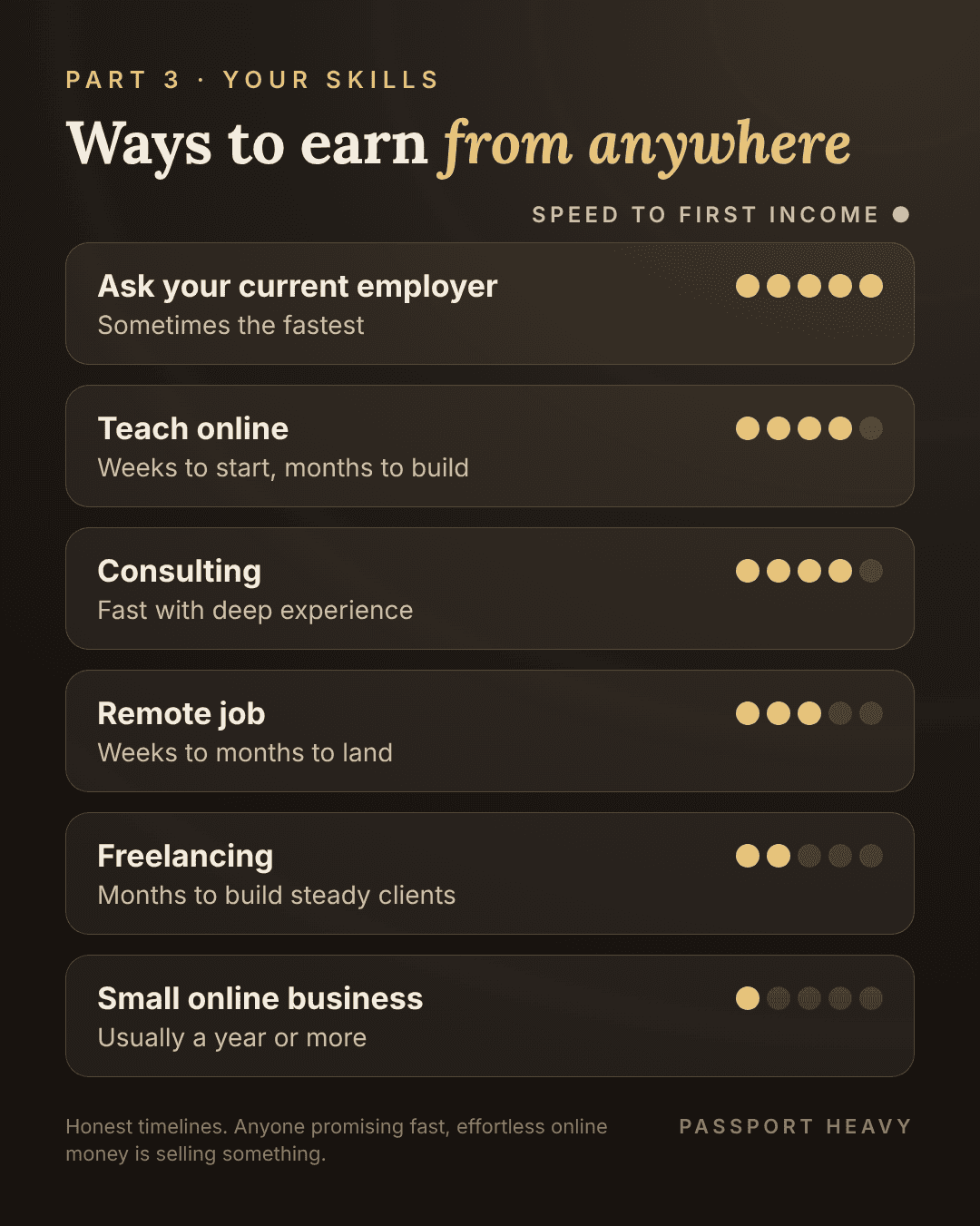
We’ll be straight with you: building income that travels usually takes time. Anyone promising quick, effortless online money is selling something. Most people who make this work start building while they still have their current income, and only lean on it once it’s proven.
Try this: four questions
Take ten minutes and write down your answers. Don’t judge them yet.
What do people already ask you for help with?
What have you done over and over, at work or in life?
Which of those things could be done through a laptop or a phone?
Who might pay for that result? Be specific: a type of person or business, not “everyone.”
If you can answer all four with something real, you have the beginnings of a service. And if you have a bachelor’s degree and speak English, you already have the beginnings of the most common one.
Takeaway: “I may not have portable income yet, but I am not necessarily starting without valuable skills.”
Go deeper: learn it from Christina
Christina walks members through exactly how she started teaching English online from nothing, and you get the Earn From Anywhere Starter Kit to turn the skills you already have into income that travels.
Learn how to earn from anywhere →
Up next: how to try it without betting everything on it. Go to Part 4 →
Part 4: You may not need to make a permanent move
Who this is for: You’re afraid of regret. Of loneliness. Of losing your financial security, your career or your community, and of making a mistake you can’t undo.
In 30 seconds
Your first decision doesn’t have to be forever.
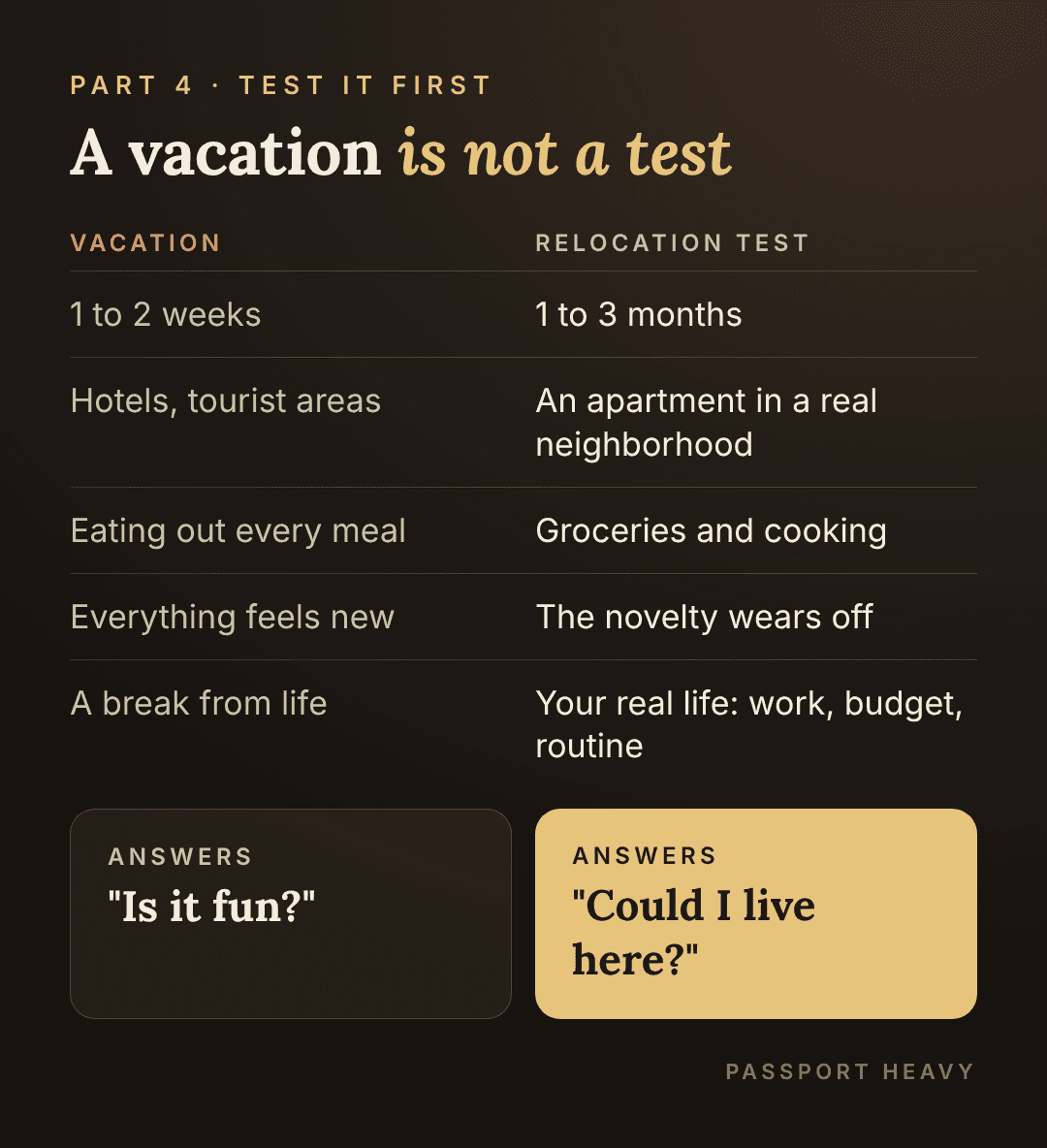
A vacation tells you if a place is fun. A one-to-three-month test tells you if you could live there.
Jubril sublet his Miami apartment and paid about $900 a month instead of $4,400.
A lot of people never look seriously at living abroad because they picture one giant, irreversible decision: sell everything, quit, leave, never look back.
That’s rarely how people who are happy abroad actually did it. Most of them tested first.
How Jubril tested it
Jubril has traveled for 16 years and been to more than 60 countries. But before he ever tried living somewhere new for months at a time, he did something he’d never done before: he sublet his Miami apartment for about three months while he went abroad to see if the life he imagined actually worked day to day.
He did it last minute. About a week before he left, he decided to try it, started putting things in place and priced it so the deal was too good to pass up. It worked. He found someone fast.
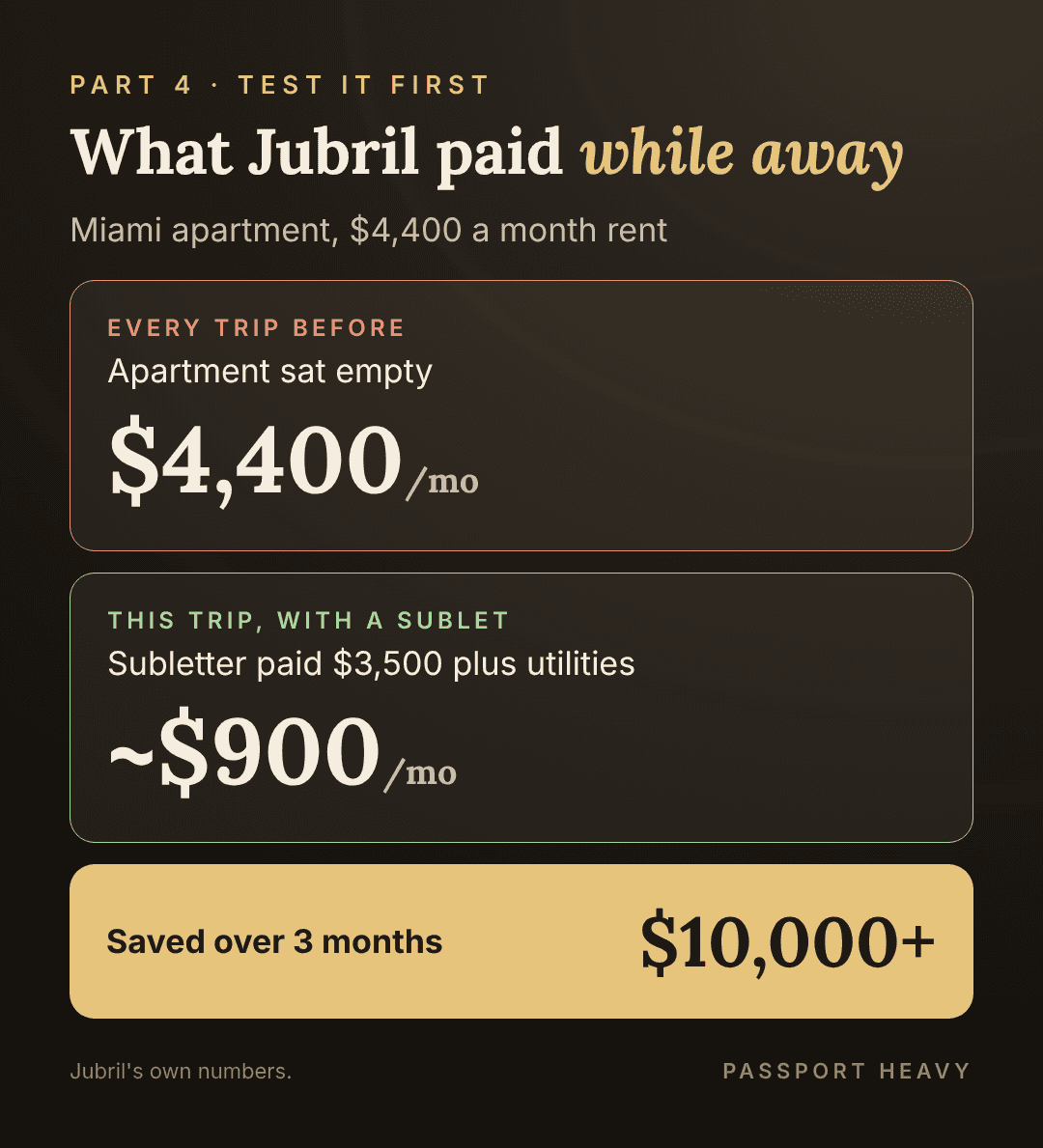
The sublet didn’t cover all his costs. But on every trip before, his place sat empty and he paid the full rent for nothing. This time, his home was being lived in, most of his housing costs were covered and he saved roughly $3,500 a month, more than $10,000 over the three months. And he still had his apartment to come back to if life abroad didn’t work out.
How he picked the right person. He set a three-month minimum, because he didn’t want strangers coming in and out of his home. He chose someone responsible with good credit, ran a background check and kept in touch the whole time. It went smoothly.
His lesson: start earlier. With more than a week to find someone, he likely could have charged closer to his full rent.
If you rent your home, read your lease before you sublet. Many leases require your landlord’s written permission, and skipping it can put your lease at risk. If you own, check your HOA or building rules and your insurance.
That’s what a test is. Not a leap. A way to find out, while every door stays open.

A vacation is not a test
Debbie, from Part 1, scouted about five places around the world before choosing Bali, and she’s clear that she wouldn’t sell everything without first understanding the culture and daily life. That’s the whole idea.
How to design a good test
Stay long enough to get bored. A month is a good minimum. You want to see an ordinary week, not just the highlights.
Live where you’d actually live. A furnished apartment or longer-stay rental in a normal neighborhood, not a resort.
Do the boring stuff. Buy groceries. Take local transportation. Find a pharmacy. Visit a clinic for a checkup. Get a haircut.
Bring your real budget. Track every dollar so you know what life there really costs you.
Keep your options open. Don’t sell the house or quit the job for a test. That’s what makes it a test.
Know how long you’re allowed to stay. Americans can usually visit most of Europe (the Schengen area, including Spain, Portugal and Greece) for up to 90 days in any 180-day period without a visa. The EU is scheduled to launch ETIAS, a €20 online travel approval, in late 2026. Check the official ETIAS site before you book. Vietnam’s e-visa allows up to 90 days. A one to three month test usually fits inside these limits. See Part 7 for longer stays.
Questions your test should answer
Write these down before you go. Answer them honestly before you come home.
Can I imagine an ordinary Tuesday here?
Can I handle the everyday friction: language, paperwork, heat, noise, things taking longer?
Do I feel healthier or less stressed than I do at home?
Does my budget actually work, month after month, not just for a trip?
Could I build real relationships here?
What would I miss most from home?

The feelings nobody puts in the brochure
Practical things are easier to plan than emotional ones. Be ready for these:

Loneliness. Even happy expats go through stretches of it, especially in the first few months. Community, whether local or expat, makes a huge difference. Toni, who you’ll meet in Part 6, has moved countries seven or eight times, and her rule never changes: join something right away. In Bangkok she joined the American Women’s Club and became its president, plus pickleball, squash, a movie group and a music group. “Before you know it,” she said, you have people who share where to see a doctor and where to spend a weekend.
Identity. At home you’re known. Abroad, you start over. Some people find that freeing. Some find it hard.
Belonging. You may always be a little bit of an outsider. Decide whether you can be at peace with that.
Missing family. Birthdays, holidays and emergencies happen while you’re far away. Know how often you’d fly home and what that costs.

None of these mean you shouldn’t go. They mean you should go with your eyes open.
Takeaway: “I do not need complete certainty. I need a safe way to gather better evidence.”
Go deeper: plan your test with people on the ground
Ask members who live in places like Da Nang what an ordinary Tuesday really costs and feels like, and plan your test with people who’ve done it, before you book anything.
Up next: what to do when the people you love aren’t sure. Go to Part 5 →
Part 5: The decision involves more than one person
Who this is for: Your partner, your kids or your wider family are uncertain, nervous or flat-out against the idea.
In 30 seconds
A hesitant partner is half of the decision, not an obstacle.
Small questions (“one month?”) get further than “should we move forever?”
Agree on your must-haves and deal-breakers before you look at places.
If your partner hears “I want to move abroad,” what they may really hear is “I want to give up everything we’ve built.” That’s scary. Of course they push back.

An unsure partner isn’t an obstacle to get around. They’re half of the decision, and their worries are often the exact things that need to be planned for.

Understand before you persuade
Resistance usually comes from something specific. Common ones:
Fear of the unknown: safety, health care, language, getting sick far from home.
Career: they love their work, or can’t see how it would continue.
Family: aging parents, grown kids, grandkids they don’t want to miss.
Kids’ schooling: worries about education, friends and stability.
Money: fear of draining savings or losing the security you’ve built.
Ask, then listen. You might discover their real concern is something very solvable. Or something that genuinely changes the plan.
Make the conversation smaller
“Should we move abroad forever?” is too big a question for any couple to answer over dinner. Try smaller ones:
“Would you be open to spending one month somewhere next year, just to see?”
“If we tried it, what would need to be true for you to feel safe?”
“Can we look at one place, one budget and one timeline together, just to see what it would really look like?”
Write down your shared rules
Sit down together and make two lists: what you must have, and what you can’t accept. For example:
Must have: a direct or easy flight home to see family. Deal-breaker: no hospital we trust within an hour.
Must have: a good school for our youngest. Deal-breaker: spending more than half our savings.
Must have: a community where we won’t feel isolated. Deal-breaker: one of us being unable to work.
Once you agree on the rules, you’re on the same side, looking at destinations together instead of debating whether to look at all.
Conversation starters
What are you most afraid we would lose?
What would make a temporary test feel safe?
Which parts of our current life must we protect?
What would make the experience worthwhile, even if we came back?
What would each of us need in order to feel settled?
Some couples do all of this and decide not to go. That’s a success too. You made the decision together, with real information.
Takeaway: “We may not agree on a permanent move, but we can investigate the possibility together.”
Go deeper: explore it together
Watch real couples talk through this exact decision, then bring your partner’s questions to a live call. Hearing it from people who’ve lived it settles what an argument never will.
Explore the community together →
Up next: health care, aging parents and everything else you’re responsible for. Go to Part 6 →
Part 6: Your responsibilities need to shape the plan
Who this is for: You have health needs, aging parents, kids in school, pets, debt, a business or other commitments that make a move feel complicated or impossible.
In 30 seconds
Sort each responsibility: what stays, what can move, what needs expert advice.
Before 65, health care abroad can cost a fraction of US prices. After 65, Medicare is the better deal at home.
Insurance gets harder to buy with age, so sort it out early.
Some responsibilities can move with you. Some can be handled differently. And some really do limit your options. The goal here is to tell them apart, instead of letting all of them together say “no” before you’ve looked.

Sort every responsibility
List every commitment you have. Then put each one in one of these groups:
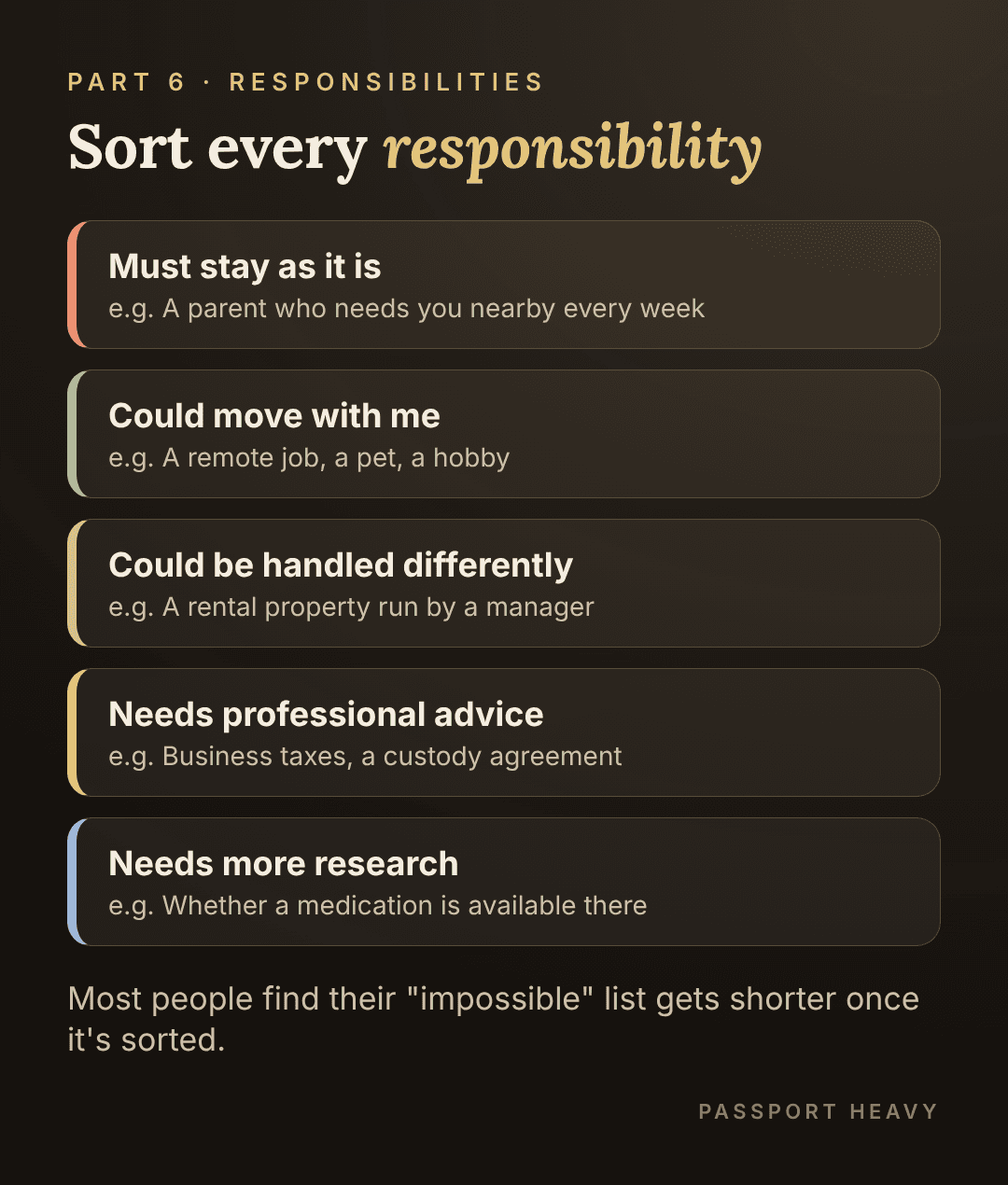
Most people find their “impossible” list gets shorter once it’s sorted.
Health care: research this first
For a lot of people, especially as Medicare age gets closer, health care is the question that decides everything. In a 2025 Harris Poll, 40% of Americans who said they would never move abroad named access to health care as a reason. It’s also the area where the real numbers surprise people most.

Meet Toni: “Ritz-Carlton at Holiday Inn prices”

Toni grew up in Oklahoma City and left at 21. She has moved countries seven or eight times since, including 15 years in Hong Kong and time in London and Japan. Now she’s around 70 and has lived in Bangkok with her husband for three years. They chose a 10-year visa and told themselves they’d commit to at least five years and see. So far, she says, it’s been fabulous.
When they were deciding where to settle, health care wasn’t an afterthought. It was one of their biggest reasons for choosing Bangkok. As you get older, she told us, “this is a real priority.” When you’re young, you don’t think about it much.
Then it got tested. Last year her husband needed two back operations. They had them done at MedPark, a newer private hospital in Bangkok. Her husband, a former investment banker who tracks every number, worked out that the total came to about one fourth of what it would have cost in Oklahoma, and Oklahoma is already cheaper than places like New York or Chicago.

The price wasn’t what she talked about most, though. It was how it felt:
No waiting. When you need an MRI, they schedule it right away, and you often get results the same day. Meanwhile, her friends in the US tell her they wait a month or more for appointments, and she sees the same doctor shortages in London.
World-class doctors who speak English. Many trained in London. Her own doctors in London and Hong Kong already knew of the specialists treating them.
Kindness. “They figure it out,” she said. When her husband was learning to walk again, strangers on the street held doors for him and offered him rides. She described feeling that compassion at a time when she was in despair.
Help at home. She pays about $250 a week, roughly $1,000 a month, for a full-time helper who is also a trained nurse from the Philippines. When her husband was recovering, that help meant Toni wasn’t his only caregiver.
Her summary for her friends: “Ritz-Carlton at Holiday Inn prices.” Big rooms. Top doctors. And if you go back, they put you in the same room you had last time, so the nurses and the floor are already familiar.
Jubril saw the same gap himself. A full preventive checkup in Bangkok cost him about $500. The same set of tests back home in the US, at UCLA or in Miami, runs about $5,000. Toni’s view on that: preventive care is the best thing you can do, because you catch problems while they’re still easy to fix.
The umbrella story. Health insurance is an umbrella. In the US, your umbrella usually comes from your job, and later from Medicare. Abroad, two things change. First, you buy your own umbrella. Second, in many countries the everyday rain, like a doctor visit or a blood test, is light enough to pay for out of your own pocket. So the umbrella is mostly there for the storms: a hospital stay, surgery, an emergency flight home.

US vs. abroad, side by side

US insurance: KFF 2026 national average for a 60-year-old buying their own plan without subsidies, and 2026 Medicare costs (Medigap is the median for new 65-year-old applicants). US doctor visit: Zocdoc 2026. Abroad: published insurer rate-sheet estimates, Q2 2026, Cities Insider and Debbie Welsch via Business Insider. Checkup and surgery figures are Jubril’s and Toni’s own experiences. Estimates, not quotes.
Read that list from top to bottom and the real story shows up. The biggest savings come before 65. If you leave a job in your 50s or early 60s, buying your own coverage in the US can cost more than rent in many cities abroad. Abroad, the same protection can cost a fraction of that, and everyday visits cost less too.
After 65, the math changes. Medicare is good value, so insurance abroad usually isn’t cheaper. The savings then come from everything else: lower-cost visits, prescriptions and, as Part 2 showed, a lower cost of living overall.
Three real people, three approaches. Debbie in Bali carries emergency-only insurance for about $124 a month and pays about $15 for a local clinic visit. Jubril, in Da Nang, uses travel insurance for emergencies, gets a full checkup every six months and pays for checkups and blood work himself.
Toni, in Bangkok, chose a top private hospital for major surgery and still paid about one fourth of what it would have cost in Oklahoma. One more thing she pointed out: Thailand’s retirement visas require proof of insurance for serious emergencies, so plan for that from the start.
What international health insurance costs by age
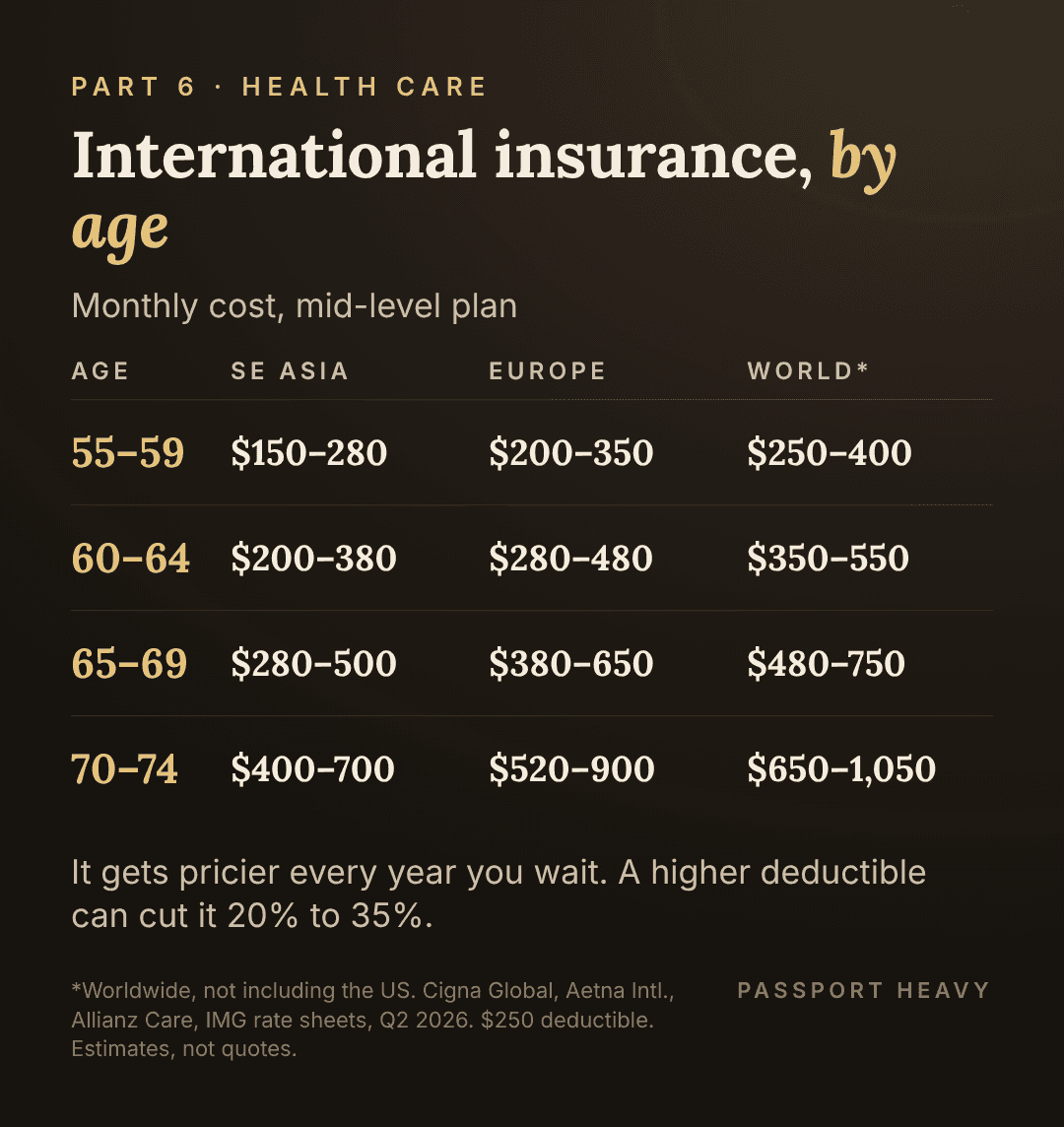
Estimates from published rate sheets of major international insurers (Cigna Global, Aetna International, Allianz Care, IMG), Q2 2026, for a mid-level plan with a $250 deductible covering hospital and doctor visits. These are not quotes. A $1,000 to $2,500 deductible can cut premiums by about 20% to 35%.
Plans get more expensive with age everywhere, and that’s one more reason to sort this out early rather than late.
Three ways people handle it

The Medicare decision at 65
Medicare generally doesn’t cover you outside the US. It’s a US umbrella.
Part A (hospital) is free for most people who worked in the US for about 10 years. It costs nothing to keep.
Part B (doctors) costs $202.90 a month in 2026. Here’s the catch: if you get Part A for free and skip Part B while living abroad, then sign up later, you pay a penalty of 10% of the premium for every 12 months you went without it, for as long as you have Part B.
So people choose. Some keep paying Part B as a backup in case they move home. Others drop it and accept the penalty risk. There’s no single right answer. A free Medicare counselor through your state’s SHIP program can walk you through it.
Don’t wait on this
Age limits are real. Most international plans stop accepting new members somewhere between 74 and 80, and many cheaper local insurers stop between 65 and 75. Earlier is easier and cheaper.
Pre-existing conditions may be excluded, cost more or have a waiting period. Ask before you buy.
Ongoing conditions need a plan. Is your medication available there? Is there a specialist? Bring a few months’ supply and your records when you go.
Use your test trip. Visit a clinic for a checkup during your test (see Part 4). You’ll learn more about the care there in one afternoon than in a week of reading.
Caring for family
If you care for a parent or relative, the questions are about distance and backup. How quickly could you get home? Who covers day-to-day care? Is there a sibling or service who can share it? Some people choose places with direct flights home, or split their year.
Others, like Debbie, bring a parent along. Moving her mom cut her mom’s housing from a looming $1,500 a month to about $350.
Kids and school
Families abroad generally choose between local schools, international schools and homeschooling or online school. International schools can be excellent but often cost a lot. Age matters too: younger kids often adapt quickly, while teenagers may have stronger ties at home. Visit schools during your test, and include your kids in the conversation.
Pets
Every country has its own import rules: vaccinations, microchips, health certificates and sometimes waiting periods. Some airlines and housing restrict certain breeds or sizes. Check early, because some requirements take months.
Debt
Debt doesn’t stop at the border, and payments still need to be made from abroad. Lower living costs can make debt easier to pay down, but know your monthly obligations before you build a budget.
Running a business
Time zones are the big one. A 12-hour difference can mean late-night calls for your whole working life there. Some businesses move easily. Others need you physically present. Think about legal and tax setup, too, and talk to a professional.
Count the cost of each commitment
For each responsibility you keep, write down what it adds: flights home, insurance, school fees, a caregiver, a property manager. Some will barely change your plan. Others may decide your destination for you.
And sometimes the honest answer is that a responsibility rules out a move for now. That isn’t failure. It’s good planning, and it tells you when to look again.
Takeaway: “My responsibilities may change the destination or timing, but they do not automatically answer the entire question.”
Don’t let health care be the reason you never look
Toni found her hospital by asking other Americans who’d been through it. In the community, you can ask members which insurance they actually pay for, what their last checkup cost and which hospitals they trust.
Get your health care questions answered →
Up next: where to actually begin. Go to Part 7 →
Part 7: Your biggest obstacle may be uncertainty
Who this is for: You want change, but between destinations, visas, money and a thousand conflicting opinions online, you feel overwhelmed and don’t know where to start.
In 30 seconds
Picking a country is step five, not step one.
A visa is a guest pass. Long stays mostly ask one thing: can you support yourself?
This week, answer just one question you can’t answer yet.
Here’s a pattern we see constantly. Someone gets excited about living abroad and starts browsing: Portugal, Mexico, Thailand, Costa Rica. Videos, blogs, cost-of-living sites, Facebook groups. Months go by. They feel like they’re making progress.
But they’re answering question five before questions one through four. Browsing destinations feels productive, and it can quietly postpone the questions that actually decide things.
The right order
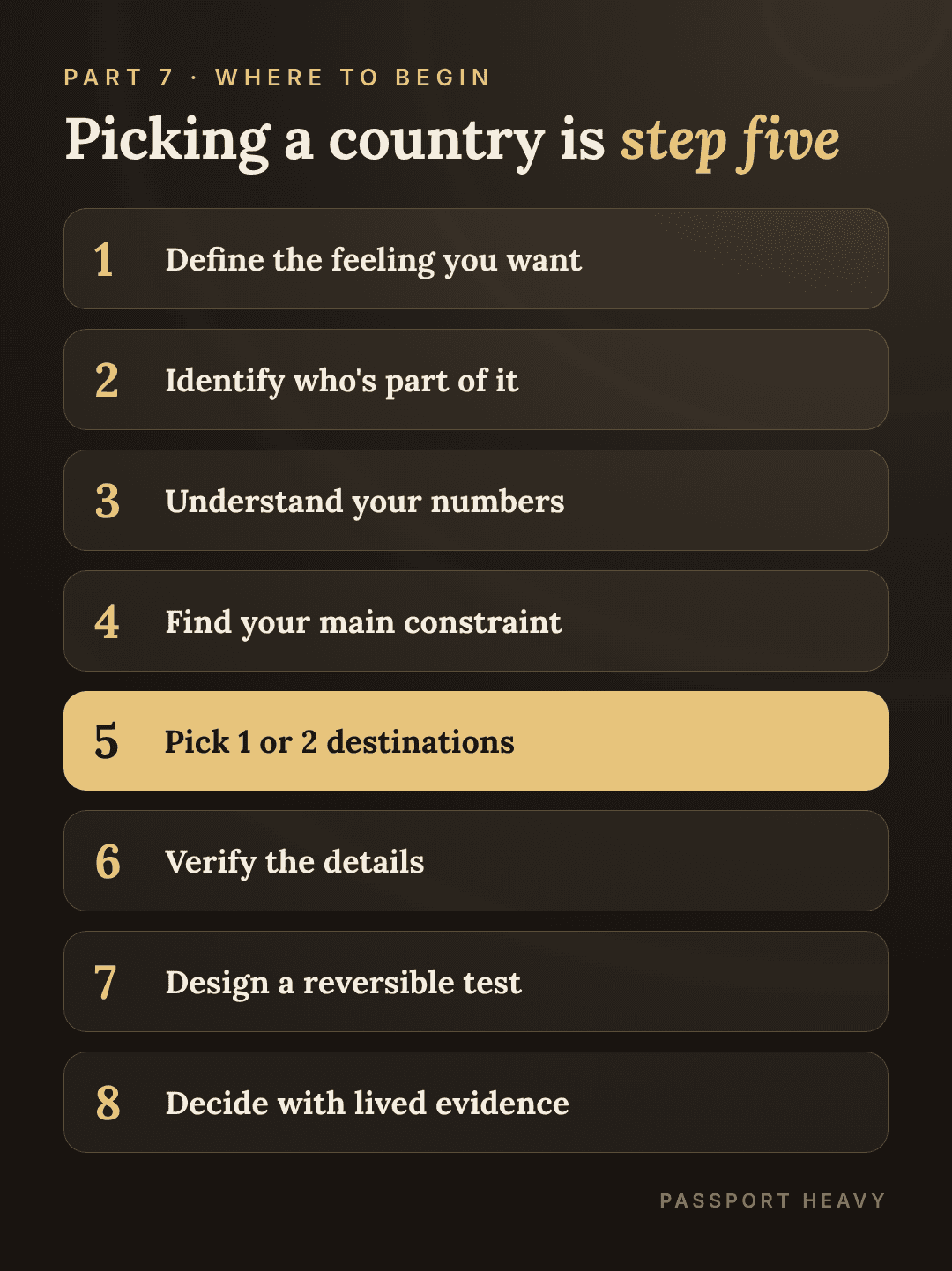
Notice that picking a country is step five, not step one.
Visas, explained like you’re 5
Your passport says who you are. A visa is a guest pass. It says how long a country will let you stay and what you’re allowed to do while you’re there.

Short guest passes, for visiting, are easy. Americans can visit many countries for weeks or months with little more than a passport. Long guest passes, for living there, usually ask one question: can you pay your own way without taking a local job? That’s why most retirement and long-stay visas ask you to show a steady monthly income or a pile of savings.
Here’s what that looks like in a few popular places, for one person, as of October 2026, and whether Carol from Part 2 ($2,750 a month, $200,000 saved) could qualify:
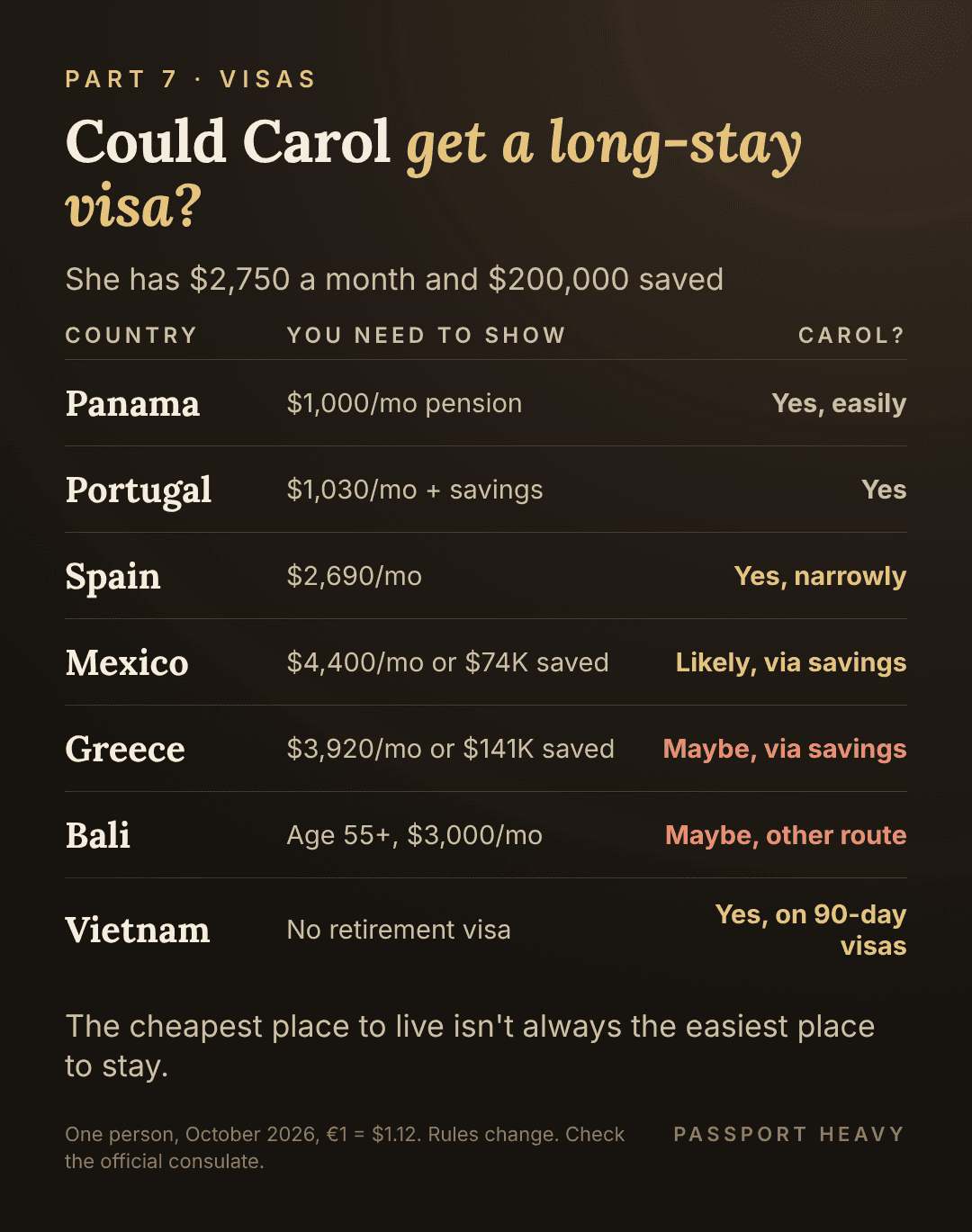

Converted at €1 = $1.12. Most of these also require health insurance and a clean background check, and some don’t let you work locally. Requirements change and can differ by consulate. Always confirm with the official consulate or an immigration lawyer before you apply.
Three things this teaches:
The cheapest place to live isn’t always the easiest place to stay. Vietnam stretches Carol’s money furthest, but Panama and Portugal give her the most long-term security for the least income.
Social Security often counts. Many retirement visas accept it as income, and Panama’s is built around it.
Savings can open doors that income can’t. Several countries accept a lump sum instead of monthly income.
How the people in this guide took their first step
Nobody in this guide solved everything at once. Each of them answered one question, then the next:

Toni’s advice for anyone who doesn’t know where to begin was simple: start educating yourself. Watch, read, compare what things cost, and get other points of view. Then, as Debbie and Jubril did, go and see for yourself.

If you only do one thing this week
Pick the first question on that list you can’t answer yet, and answer it. That’s it. Not the whole plan. Just the next useful question.
Takeaway: “I do not need a perfect plan today. I need to answer the next useful question.”
Go deeper: answer the next question with us
You don’t need to work through this list alone. Bring whatever question you’re stuck on to a live call. Someone in the community has usually been there.
Up next: what to do with everything you now know. Go to the wrap-up →
Knowing an option is not the same as choosing it
You may finish this guide and decide life abroad isn’t for you. Or not yet. Or only for part of the year. Every one of those is a good result, as long as you decided with real information instead of assumptions.

Jubril put it this way. He’s spending the next year living in and investigating places around the world, not because he’s sure he’s leaving Miami for good, but because he feels he owes it to himself to understand what other options exist. He may end up back in Miami. If he does, it’ll be because he chose it, not because he never knew there was anything else.

That’s the whole idea of this guide. Your home, your income, your skills, your family and your responsibilities may hold more options than you realized. Or they may confirm that where you are is exactly right.

You do not have to use every option you create. But you cannot choose an option you do not know exists.
Build your options with people who understand the decision

If you want help turning these ideas into something specific to your life, join our private community.
You’ll meet people at different stages, including people who were once in your position and have now done it.
Come with your questions, your numbers and your doubts. You don’t need to arrive with a finished plan.
Explore the private community →
This guide is for general education only. It isn’t financial, tax, legal or immigration advice, and neither are the Relocation Reality Check results. Individual stories, including Debbie’s and Jubril’s, show what’s possible for some people, not what everyone should expect. Prices, visa rules and tax laws change. Talk to licensed professionals about your situation before making decisions about your home, income or residency.
If this helped, sign up for the newsletter on this page so you get the next breakdown first.
Sources
ICE August 2026 Mortgage Monitor, via Traders Union (record $18T equity, $212K tappable)
Offerpad: Real estate commission rates 2026
Business Insider, “The Pay Check”: Debbie Welsch in Bali
MoneyLion, citing SSA: average retired-worker benefit, July 2026
Realtor.com September 2026 rent report (August data)
KFF 2025 Employer Health Benefits Survey, via Managed Healthcare Executive
Vietnam average worker income Q3 2026: Vietnam National Statistics Office
NerdWallet, citing Fed Survey of Consumer Finances: median retirement savings ages 65 to 74
Wise: Cost of living in Miami (2026)
Wise: Cost of living in Valencia (2026)
Wise: Cost of living in Athens (2026)
Wise: Cost of living in Da Nang (2026)
HousingWire: 2026 Medicare Part B premium
Costa Luz Lawyers: IPREM and the Spain non-lucrative visa, 2026
Global Citizen Solutions: Greece FIP visa, 2026
SSA POMS: Payments to beneficiaries in Vietnam
Pound Sterling Live: EUR/USD and GBP/USD closing rates, Oct 23, 2026
TEFL.org: How much can I earn teaching English online in 2026?
Shareuhack: Vietnam digital nomad visa guide 2026
Greenback Tax Services: 2026 IRS changes for US expats (FEIE $132,900)
Taxes for Expats: Foreign earned income exclusion and self-employment tax
KFF: Loss of enhanced premium tax credits and older adults (2026)
RetireFinder: Health insurance for retirees abroad 2026
Cities Insider: Da Nang health care guide
AARP: Medicare Part B late enrollment penalty
Global Citizen Solutions: Panama Pensionado visa 2026
Portugalist: D7 visa changes 2026
GPA: Spain digital nomad visa 2026 income requirement
Lorad: Mexico temporary residency 2026
Emerhub: Bali retirement KITAS and Second Home Visa
WhereNext: Vietnam retirement visa 2026
Freaking Nomads: ETIAS for US citizens
The Harris Poll: American Expats Survey (Feb 2025)
Zocdoc: Primary care visit cost without insurance (2026)
United Medicare Advisors: Medigap Plan G costs 2026
CMS: 2026 Part D base beneficiary premium
Medicare.gov: Travel outside the U.S.
Tuoi Tre News: Health insurance for expat retirees in Vietnam
Da Nang prices: Jubril’s own receipts and rent, October 2026

Don't miss a thing!
Don't miss a thing as we explore better ways to travel, live, and invest around the world.

Featured Posts


Subscribe to our newsletter
Subscribe to our free weekly newsletter that features the best of travel, investment, and culture of the cities you love the most.
Related Stories

Oct 6, 2026
Invest Abroad
Will vs Trust, Explained Like You're 5
Read more

Sep 23, 2026
Live Abroad
Cost of Living in Bangkok in 2026: Alex’s Real Budget
Read more

Sep 20, 2025
Live Abroad
How I Flew Business Class for $160 on an $8,198 Flight
Read more

Sep 19, 2025
Travel Abroad
10 High-Paying Digital Nomad Jobs That Let You Work From Anywhere
Read more
Could Life Abroad Actually Work for You?
Most people rule out living abroad using the wrong numbers. Here is how to check yours, one part of your life at a time.
Before you pick a country, find out what is realistic for you
Living abroad can sound like a dream or a gamble. The honest answer depends on your home, your income, your skills, your family and your responsibilities, and most people never look at those clearly. This guide does, one area at a time.
Get your personalized starting point
Answer a few questions about your income, savings, property, responsibilities and what you want from daily life.
In about three minutes, the Relocation Reality Check will show what may already be working in your favor and what deserves more attention.
Take the free Relocation Reality Check →
Tap the part that sounds most like you to jump straight to it
Each part stands on its own, so you can come back to the others later. Read it all and it takes about 30 minutes. Or tap the part that sounds like you and start there.
If you've watched Passport Heavy for a while, you've probably said one of these out loud. Maybe to your screen. Maybe to yourself.
"That worked for them, but it wouldn't work for me."
"I don't have enough money."
"My income can't move."
"I still have a mortgage."
"My family would never agree."
"I have too many responsibilities."
"I wouldn't know where to begin."
Some of those concerns are real. A few of them might be the reason living abroad isn't right for you, at least not yet. That's a perfectly good outcome.
But here's something we see over and over. People judge their options using only the prices, the rules and the assumptions of the place they live right now. They look at their mortgage and see debt, not the value they've built. They look at their paycheck and compare it to American prices only. They assume a move has to be permanent, all at once, and perfect on the first try.
This guide walks through seven areas, one at a time. In each one, you'll see what might already be working in your favor, what deserves more attention, and what to look into next. It isn't here to convince you to move. It's here to help you look at the possibility honestly, with better information than you had before.
Part 1: Your home may contain more freedom than you realize
Who this is for: You own a home, you still have a mortgage, and that unfinished mortgage feels like a chain keeping you where you are.
In 30 seconds
What you owe and what you own are two different numbers.
Equity can mean selling, downsizing, renting it out, or keeping the house while you test.
The same $300,000 lasts about twice as long in a city like Da Nang.
Most homeowners can tell you their mortgage balance to the dollar. Ask them how much of the house they actually own, and they have to think about it.
That’s not an accident. The mortgage shows up every month as a bill. The value you’ve built doesn’t show up anywhere unless you go looking for it.
What equity actually is
Equity is what your home would likely sell for, minus what you still owe on it.
In that example, you still have a mortgage. You also own about a quarter of a million dollars of value. Both are true at the same time.
You wouldn’t be unusual. In the second quarter of 2026, American homeowners with a mortgage held a record $18 trillion in equity, and the average one had about $212,000 they could borrow against while still keeping a cushion in the house.
Why people overlook it
The debt is loud, the value is quiet. You feel the payment every month. You never feel the equity unless you sell or borrow.
It doesn’t feel spendable. And honestly, it isn’t, not until you do something with the house.
We compare it to where we live. $260,000 doesn’t buy much of a new home in most American cities, so it feels small. Somewhere with lower day-to-day costs, the same amount can do a lot more.
The four main ways equity can create options
Renting only works if the rent covers the mortgage, taxes, insurance, repairs, management and empty months. (Jubril sublet his Miami apartment for three months to test. See Part 4.)
The same equity, very different flexibility
Here’s a simple way to see it. Say you sell and walk away with $300,000 after selling costs and the mortgage payoff. How long would that cover your living costs, before any investment growth or other income?
Simple division for illustration only. Real plans include investment growth, inflation, taxes, Social Security, health insurance and other income.
Nothing about the money changed between those rows. Only the place changed.
What equity is not
Equity is not cash in your pocket. Before you count on it:
Selling costs money. Agent commissions averaged about 5.5% to 5.7% in 2026, plus closing costs.
Taxes can apply. In the US, a single person can usually keep up to $250,000 of profit on a main home tax-free ($500,000 for married couples), if they owned and lived in it for 2 of the last 5 years. Profit above that can be taxed.
Renting isn’t free money. Maintenance, insurance, property managers and months without a tenant all come out of the rent.
Borrowing has a cost. A home equity loan or line of credit lets you keep the house, but you pay interest every month on what you take.
Get professional advice. A tax professional and a financial planner can show you what you’d really keep.
Selling is never automatically the right answer. For some people it’s the key that unlocks everything. For others, keeping the house is the smarter move. The point is to know what you have.
Want the full math? Our upcoming post on home equity will walk one homeowner through selling, renting and borrowing, with every number shown.
A real example: Debbie Welsch
Business Insider’s series “The Pay Check” featured Debbie Welsch, and her story shows this shift better than any example we could invent. All credit to Business Insider and to Debbie for sharing her real numbers.
“Money is the first thing I’d think of when I wake up, and money’s the last thing I’d think of when I go to sleep.” Today, she says, “It’s not like that anymore.”
Debbie is also clear that she wouldn’t sell everything and move without first getting to know the culture and what ordinary daily life is really like. That’s why she scouted first.
Her situation won’t match yours. You may not have $550,000 of equity, you may not want Bali, and you may have people and responsibilities she doesn’t. The lesson isn’t “sell your house.” It’s this: changing her location changed what her existing assets could provide.
Watch Debbie’s full story on Business Insider’s YouTube channel
Takeaway: “My mortgage may still be a responsibility, but it does not necessarily mean I have no financial options.”
You don’t have to figure this out alone
Debbie’s numbers won’t match yours. Inside our private community, members who sold, rented out or kept their homes share what they’d do differently, and you can bring your own numbers to a property and investing session.
See inside the private community →
Up next: Your home is one lever. Next, what your income can actually buy somewhere else. Go to Part 2 →
Part 2: Your income may be worth more somewhere else
Who this is for: You have income, from a job, remote work, a pension, Social Security or investments, and you still feel like you can’t afford the life you want.
In 30 seconds
Your income is only half the equation. Where you spend it is the other half.
A typical retiree’s $2,750 comes up $1,200 short in Miami and leaves over $1,000 spare in Da Nang.
Affording a country and being allowed to live there are two separate questions.
A $2,500 monthly income means one thing in San Diego and something completely different in Da Nang, Athens or Valencia. The number on the check is the same. What it buys isn’t.
That idea has a name: purchasing power. It just means how much life your money can buy where you spend it.
The $20 bill story
Picture a $20 bill. In one store, it buys you a sandwich and a drink. Walk into a different store across town, and the same $20 buys lunch for two with dessert.
The bill didn’t change. It’s the same paper, the same $20. Only the store changed.
Your Social Security check, your pension and your savings work exactly the same way. The amount stays the same wherever you go. The “store” you spend it in is what decides how far it goes.
Meet Carol, an example retiree
Carol is made up, but her numbers are the national typical numbers:
Carol isn’t rich and she isn’t broke. She’s right in the middle. Now let’s see what her $2,750 does in four cities (two budgets in Da Nang).
Same check, four cities
Rent is a typical 1-bedroom outside the city center, and “everything else” is a single person’s typical monthly costs without rent, both from Wise’s 2026 cost-of-living data (Athens converted from pounds at Oct 23, 2026 rates). Jubril’s apartment is his real rent. Health insurance is our estimate: in Miami, Medicare Part B ($202.90 a month in 2026) plus a supplement and drug plan; abroad, a private international plan for someone in their 60s. Your numbers will differ.
In Miami, Carol comes up about $1,200 short every month. She has to drain her savings faster, cut back hard, or go back to work. In Valencia, Athens or Da Nang, the exact same income covers her life and leaves money over, from about $500 to more than $1,600 a month. That extra is a cushion for emergencies, travel home to see family, or simply not worrying.
And notice: Carol doesn’t have to pick the bare-minimum option to make it work. Even in Jubril’s modern riverside apartment in Da Nang, she has over $1,000 left each month.
Carol is made up. Genise isn’t.
Genise spent her career in corrections. After she retired, she worked part-time for Delta for about eight years, and flying internationally changed how she saw the rest of the world. Two years ago, she moved to Bangkok. Her daughter lives there too, and another daughter is on her way to join them.
She lives mainly off her pension. She doesn’t touch her Social Security or her savings, and she still has money left over. Her two-bedroom apartment costs about $900 a month. Back home, she says, she could have covered the basics, but not the extras that are now part of her normal week: massages, private Pilates and pickleball lessons.
“Here, you can do all that and have change.”
She didn’t pick Bangkok off a list. In every country she considered, she looked for the local expat community first, and Bangkok’s was the one that felt like home. Her advice for anyone still on the fence: “I would have definitely done it sooner.”
Before Carol packs: can she actually live there?
Here’s the part most “cheapest places to retire” lists leave out. Affording a place and being allowed to live there are two different questions.
Visa amounts as of October 2026, converted at €1 = $1.12. These rules change, so always check the official consulate before you plan around one. For more countries, see the visa section in Part 7.
So the honest picture is this. Spain works for Carol, just barely. Greece may work through her savings rather than her income. Vietnam gives her the most room in her budget but the least long-term legal security. There’s no perfect answer, only trade-offs, and now she can see them.
One more thing: taxes. Greece offers a flat 7% tax on foreign pension income for some retirees who move their tax residence there. Spain taxes residents on worldwide income, with special rules for US Social Security under the US-Spain tax treaty. And US citizens file US taxes wherever they live. Talk to a cross-border tax professional before you choose.
Now do your own math
Grab a pen. This takes two minutes.
1. Your monthly Social Security (find it at ssa.gov/myaccount): $________
2. Your pension, if you have one: $________
3. Your savings x 0.04, divided by 12 (a common rule of thumb for a safe monthly withdrawal): $________
4. Any other income (rental, part-time work): $________
Your monthly income (add 1 to 4): $________
Now compare it to the monthly costs in the five-cities chart above, or to any city you’re curious about. If your income is above that cost, that city could work on paper. Then check the visa rule. If it’s below, that’s useful too: it tells you which places to cross off, or how much more income you’d need.
Jubril’s real prices in Da Nang
Averages are helpful, but nothing beats real receipts. Here’s what everyday life actually costs Jubril in Da Nang in 2026:
Prices converted at about 26,000 Vietnamese dong to $1, October 2026.
We use Da Nang a lot because it’s where we filmed and where Jubril lives. It’s one example to show how purchasing power works, not a recommendation that everyone should move there.
The five big costs to compare
When you compare any destination to home, look at these five, in this order:
Housing. Usually the biggest swing. Compare the kind of place you’d actually want to live in, not the cheapest listing you can find.
Food. Groceries and eating out. Local food is usually far less expensive than imported Western brands.
Getting around. Many people abroad don’t need a car at all. That can remove a car payment, insurance and gas in one move.
Utilities and phone. Electricity can be expensive in hot places if you run air conditioning all day.
Health care. Often much less expensive per visit, but you’ll likely need private international insurance. In the US, the average employer plan for one person cost about $9,325 a year in 2025, and that’s the version where your boss pays most of it.
Local life vs. expat bubble
Two people can live in the same city on very different budgets. One shops at local markets, eats where locals eat and rents in a neighborhood with real families. The other lives in an expat high-rise, eats imported food and spends every night where tourists go. Both are valid. They just cost very different amounts.
Be honest with yourself about which life you’d really want. Then price that life, not the fantasy version or the bare-minimum version.
A word on perspective
What feels inexpensive to you is a real price to the people who live there. In Vietnam, the average worker earned about $354 a month in Q3 2026. That $70 dinner is about a fifth of a local monthly paycheck. You’re a guest in someone’s home city. Be conscious of that, and never call it “cheap” at the table.
What purchasing power doesn’t solve
Affordability isn’t a visa. Being able to afford a country doesn’t mean you’re allowed to live there long term. Each country has its own rules.
It isn’t a personality fit. Heat, noise, language and pace of life matter as much as price.
Costs change. Prices rise abroad too, and exchange rates move. Build in a cushion.
Takeaway: “My income might support a very different quality of life in another location.”
Go deeper: check your numbers with people living on them
Carol is an average. You’re not. Members living in Da Nang right now, including Tiffany and Majida, share what life actually costs them, and you can bring your own budget to a live call.
Go deeper inside the community →
Up next: what if your income can’t move with you? Go to Part 3 →
Part 3: You may already have skills that can travel
Who this is for: Your income is tied to where you live. Your job needs you in a building, a hospital, a classroom or a job site, and you can’t picture what else you’d do.
In 30 seconds
You may not need a new career, just a way to deliver what you already do online.
Teaching English online is one of the most common first steps we see, and you don’t need to speak your students’ language.
Making less can still mean keeping more.
When people say “I don’t have any skills that work online,” what they usually mean is “I’ve never thought of what I do as something I could sell on its own.” Those are very different things.
Before we get into skills and options, meet two people who started from about as close to zero as it gets.
A real example: Ralph and Christina
Ralph and Christina are members of our private community, and they’re in our upcoming Da Nang episode, where you’ll see the home they rent there for about $450 a month.
What you might not know is how they got there. Back in the US, Ralph’s business failed. Christina was a nurse. They lost almost everything and had to start over. So they did something most people would never consider: they left everything behind and moved abroad.
They needed income that could come with them, so they both started teaching English online. Not at a school in Vietnam. Online, from home, to students in China. Christina started first, when they began living abroad. Ralph followed.
Here’s the part that stopped people in their tracks when Christina explained it on one of our community calls: neither of them speaks Chinese. Not a word of it. The lessons are in English, because English is what the students are paying to learn.
Almost everyone in the room had assumed you’d need to speak your students’ language first. You don’t. If you’re reading this, you already speak the language people are paying for. Teaching it well is a skill you build, but the hardest part, the language itself, you already have.
They make less than many people reading this. And they save more than most of them.
Make less, keep more: the bucket story
Imagine two buckets under a faucet.
The first bucket is big. Lots of water pours in. But there’s a giant hole in the bottom, and almost all of it drains right back out. At the end of the day, there’s a puddle.
The second bucket is smaller. Less water pours in. But the hole is tiny. At the end of the day, it’s half full.
The faucet is your income. The hole is your cost of living. What’s left in the bucket is your actual life: your savings, your freedom, your options.
The “big bucket” is an example of a typical household on a good American income, not Ralph and Christina’s old numbers.
Here’s the hard part, and it’s not the math. It’s the feeling. Going from $6,000 a month to $2,000 or $2,500 sounds like failing. A lot of people hear “I’d make less” and their brain translates it to “I’d be less.”
But the paycheck was never the score. What’s left at the end of the month is the score. Ralph and Christina keep about four times as much as the big-bucket household, and they work on their own schedule. As they found out, making less money gave them more freedom and more money left over.
Why teaching online is the most common first step
Of all the ways people earn from abroad, this is one of the most common paths we see in our community, especially for people starting over. Here’s why it works:
Huge demand. Millions of people around the world want to learn English from a native speaker.
Your students are somewhere else. You teach people in other countries over video. You’re not taking a job from a local teacher, and you don’t need to find a teaching job in the country you live in.
It goes where you go. All you need is a laptop, a quiet spot and good internet.
The bar to start is lower than most careers. For many companies, the main requirement is a bachelor’s degree in any subject.
A TEFL certificate is a short course in Teaching English as a Foreign Language. Most employers and many students expect one. Pay rates from TEFL.org’s 2026 guide.
What does $2,000 a month take? At $15 to $20 an hour, that’s roughly 100 to 130 hours of teaching a month, or about 25 to 30 hours a week. Most people start at a lower rate, then raise it as reviews come in. It’s real work. It’s also work you can do in shorts with the sliding door open to a balcony.
And notice something about Christina. She was a nurse. Explaining complicated things to nervous people, with patience, is most of what a good teacher does. She didn’t throw her experience away. She moved it.
A different path: Amina
Ralph and Christina had degrees and work history to lean on. Amina’s story starts somewhere else.
She spent ten years as a flight attendant, then left for her health and her lifestyle. She hadn’t been to university. After a decade in a job that required her to be physically on a plane, constantly traveling, she didn’t feel like she had any obvious skills that could move online.
So she didn’t wait for a company to hire her. She found her own students, people in Russia who want to learn English, through Instagram and different online communities. She started at about $12 an hour. She quickly had more students than she could handle, and now charges about $30 an hour.
Here’s the most important part. Amina isn’t trying to build a huge business. She knows how much she wants to earn, and she teaches three or four hours a day, at most. The rest of her day is rock climbing, pickleball and all the things she never had room for before.
At $30 an hour, three to four hours a day, five days a week, that works out to roughly $1,950 to $2,600 a month. In Da Nang, that’s a full life. She works less than she ever has, and has the best lifestyle she’s ever had. Before she moved, she would never have thought to design her life that way.
Two very different starting points. Same lesson: the skill they needed was speaking English, and they already had it. And it doesn’t have to be English. If you speak another language fluently, whether Spanish, French, Portuguese, Arabic, Yoruba or anything else, there are students looking for you too.
The fine print
Visas. Rules for working online while living abroad are different in every country. Some, like Spain, offer a digital nomad visa built for remote workers. In others, the rules for remote work are less clear. Check the rules where you plan to live before you count on this income there, and get professional advice if you’re unsure.
US taxes. US citizens file taxes no matter where they live. The Foreign Earned Income Exclusion can let you exclude up to $132,900 of earned income from federal income tax in 2026, if you spend at least 330 full days outside the US in a 12-month period or qualify as a resident abroad. But if you’re self-employed, it does not remove self-employment tax, which is about 15.3%. Build that into your budget and talk to an expat tax professional.
It’s not guaranteed. Students cancel, platforms change their rules, and time zones can mean early mornings or late nights. Start building it before you depend on it, if you can.
Skills hide in places you don’t look
Teaching is the most common path, not the only one. Think about everything you’ve done, not just your job title.
Your job: Customer service, sales, scheduling, training new people, handling complaints, reporting, managing vendors
Raising kids: Organization, scheduling, budgeting, negotiation, patience, crisis management
Caring for a parent: Coordinating doctors and insurance, research, paperwork, advocacy
Running a household: Budgeting, project management, comparing options, hiring and managing contractors
Volunteering: Event planning, fundraising, recruiting, community building, writing
A school administrator who juggles 40 parents, 12 teachers and a principal every day is doing project coordination. A nurse who explains complicated things to scared people is a communicator and an educator. A retail manager who hires, trains and schedules a team is running operations.
Having a skill vs. selling a service
Here’s the gap most people get stuck in. A skill is something you can do. A service is a specific result someone will pay for.
Skill: “I speak English.” Service: “I help adults in Japan practice business English for job interviews, 45 minutes a session.”
Skill: “I’m organized.” Service: “I manage calendars, inboxes and travel for two busy business owners, 10 hours a week each.”
Skill: “I’m good with people.” Service: “I handle customer support emails for an online store, five days a week.”
Skill: “I know insurance billing.” Service: “I review medical bills for families and find errors.”
The service version tells someone exactly what they’re getting and what problem goes away. That’s what people pay for.
The main ways people earn from anywhere
We’ll be straight with you: building income that travels usually takes time. Anyone promising quick, effortless online money is selling something. Most people who make this work start building while they still have their current income, and only lean on it once it’s proven.
Try this: four questions
Take ten minutes and write down your answers. Don’t judge them yet.
What do people already ask you for help with?
What have you done over and over, at work or in life?
Which of those things could be done through a laptop or a phone?
Who might pay for that result? Be specific: a type of person or business, not “everyone.”
If you can answer all four with something real, you have the beginnings of a service. And if you have a bachelor’s degree and speak English, you already have the beginnings of the most common one.
Takeaway: “I may not have portable income yet, but I am not necessarily starting without valuable skills.”
Go deeper: learn it from Christina
Christina walks members through exactly how she started teaching English online from nothing, and you get the Earn From Anywhere Starter Kit to turn the skills you already have into income that travels.
Learn how to earn from anywhere →
Up next: how to try it without betting everything on it. Go to Part 4 →
Part 4: You may not need to make a permanent move
Who this is for: You’re afraid of regret. Of loneliness. Of losing your financial security, your career or your community, and of making a mistake you can’t undo.
In 30 seconds
Your first decision doesn’t have to be forever.
A vacation tells you if a place is fun. A one-to-three-month test tells you if you could live there.
Jubril sublet his Miami apartment and paid about $900 a month instead of $4,400.
A lot of people never look seriously at living abroad because they picture one giant, irreversible decision: sell everything, quit, leave, never look back.
That’s rarely how people who are happy abroad actually did it. Most of them tested first.
How Jubril tested it
Jubril has traveled for 16 years and been to more than 60 countries. But before he ever tried living somewhere new for months at a time, he did something he’d never done before: he sublet his Miami apartment for about three months while he went abroad to see if the life he imagined actually worked day to day.
He did it last minute. About a week before he left, he decided to try it, started putting things in place and priced it so the deal was too good to pass up. It worked. He found someone fast.
The sublet didn’t cover all his costs. But on every trip before, his place sat empty and he paid the full rent for nothing. This time, his home was being lived in, most of his housing costs were covered and he saved roughly $3,500 a month, more than $10,000 over the three months. And he still had his apartment to come back to if life abroad didn’t work out.
How he picked the right person. He set a three-month minimum, because he didn’t want strangers coming in and out of his home. He chose someone responsible with good credit, ran a background check and kept in touch the whole time. It went smoothly.
His lesson: start earlier. With more than a week to find someone, he likely could have charged closer to his full rent.
If you rent your home, read your lease before you sublet. Many leases require your landlord’s written permission, and skipping it can put your lease at risk. If you own, check your HOA or building rules and your insurance.
That’s what a test is. Not a leap. A way to find out, while every door stays open.
A vacation is not a test
Debbie, from Part 1, scouted about five places around the world before choosing Bali, and she’s clear that she wouldn’t sell everything without first understanding the culture and daily life. That’s the whole idea.
How to design a good test
Stay long enough to get bored. A month is a good minimum. You want to see an ordinary week, not just the highlights.
Live where you’d actually live. A furnished apartment or longer-stay rental in a normal neighborhood, not a resort.
Do the boring stuff. Buy groceries. Take local transportation. Find a pharmacy. Visit a clinic for a checkup. Get a haircut.
Bring your real budget. Track every dollar so you know what life there really costs you.
Keep your options open. Don’t sell the house or quit the job for a test. That’s what makes it a test.
Know how long you’re allowed to stay. Americans can usually visit most of Europe (the Schengen area, including Spain, Portugal and Greece) for up to 90 days in any 180-day period without a visa. The EU is scheduled to launch ETIAS, a €20 online travel approval, in late 2026. Check the official ETIAS site before you book. Vietnam’s e-visa allows up to 90 days. A one to three month test usually fits inside these limits. See Part 7 for longer stays.
Questions your test should answer
Write these down before you go. Answer them honestly before you come home.
Can I imagine an ordinary Tuesday here?
Can I handle the everyday friction: language, paperwork, heat, noise, things taking longer?
Do I feel healthier or less stressed than I do at home?
Does my budget actually work, month after month, not just for a trip?
Could I build real relationships here?
What would I miss most from home?
The feelings nobody puts in the brochure
Practical things are easier to plan than emotional ones. Be ready for these:
Loneliness. Even happy expats go through stretches of it, especially in the first few months. Community, whether local or expat, makes a huge difference. Toni, who you’ll meet in Part 6, has moved countries seven or eight times, and her rule never changes: join something right away. In Bangkok she joined the American Women’s Club and became its president, plus pickleball, squash, a movie group and a music group. “Before you know it,” she said, you have people who share where to see a doctor and where to spend a weekend.
Identity. At home you’re known. Abroad, you start over. Some people find that freeing. Some find it hard.
Belonging. You may always be a little bit of an outsider. Decide whether you can be at peace with that.
Missing family. Birthdays, holidays and emergencies happen while you’re far away. Know how often you’d fly home and what that costs.
None of these mean you shouldn’t go. They mean you should go with your eyes open.
Takeaway: “I do not need complete certainty. I need a safe way to gather better evidence.”
Go deeper: plan your test with people on the ground
Ask members who live in places like Da Nang what an ordinary Tuesday really costs and feels like, and plan your test with people who’ve done it, before you book anything.
Up next: what to do when the people you love aren’t sure. Go to Part 5 →
Part 5: The decision involves more than one person
Who this is for: Your partner, your kids or your wider family are uncertain, nervous or flat-out against the idea.
In 30 seconds
A hesitant partner is half of the decision, not an obstacle.
Small questions (“one month?”) get further than “should we move forever?”
Agree on your must-haves and deal-breakers before you look at places.
If your partner hears “I want to move abroad,” what they may really hear is “I want to give up everything we’ve built.” That’s scary. Of course they push back.
An unsure partner isn’t an obstacle to get around. They’re half of the decision, and their worries are often the exact things that need to be planned for.
Understand before you persuade
Resistance usually comes from something specific. Common ones:
Fear of the unknown: safety, health care, language, getting sick far from home.
Career: they love their work, or can’t see how it would continue.
Family: aging parents, grown kids, grandkids they don’t want to miss.
Kids’ schooling: worries about education, friends and stability.
Money: fear of draining savings or losing the security you’ve built.
Ask, then listen. You might discover their real concern is something very solvable. Or something that genuinely changes the plan.
Make the conversation smaller
“Should we move abroad forever?” is too big a question for any couple to answer over dinner. Try smaller ones:
“Would you be open to spending one month somewhere next year, just to see?”
“If we tried it, what would need to be true for you to feel safe?”
“Can we look at one place, one budget and one timeline together, just to see what it would really look like?”
Write down your shared rules
Sit down together and make two lists: what you must have, and what you can’t accept. For example:
Must have: a direct or easy flight home to see family. Deal-breaker: no hospital we trust within an hour.
Must have: a good school for our youngest. Deal-breaker: spending more than half our savings.
Must have: a community where we won’t feel isolated. Deal-breaker: one of us being unable to work.
Once you agree on the rules, you’re on the same side, looking at destinations together instead of debating whether to look at all.
Conversation starters
What are you most afraid we would lose?
What would make a temporary test feel safe?
Which parts of our current life must we protect?
What would make the experience worthwhile, even if we came back?
What would each of us need in order to feel settled?
Some couples do all of this and decide not to go. That’s a success too. You made the decision together, with real information.
Takeaway: “We may not agree on a permanent move, but we can investigate the possibility together.”
Go deeper: explore it together
Watch real couples talk through this exact decision, then bring your partner’s questions to a live call. Hearing it from people who’ve lived it settles what an argument never will.
Explore the community together →
Up next: health care, aging parents and everything else you’re responsible for. Go to Part 6 →
Part 6: Your responsibilities need to shape the plan
Who this is for: You have health needs, aging parents, kids in school, pets, debt, a business or other commitments that make a move feel complicated or impossible.
In 30 seconds
Sort each responsibility: what stays, what can move, what needs expert advice.
Before 65, health care abroad can cost a fraction of US prices. After 65, Medicare is the better deal at home.
Insurance gets harder to buy with age, so sort it out early.
Some responsibilities can move with you. Some can be handled differently. And some really do limit your options. The goal here is to tell them apart, instead of letting all of them together say “no” before you’ve looked.
Sort every responsibility
List every commitment you have. Then put each one in one of these groups:
Most people find their “impossible” list gets shorter once it’s sorted.
Health care: research this first
For a lot of people, especially as Medicare age gets closer, health care is the question that decides everything. In a 2025 Harris Poll, 40% of Americans who said they would never move abroad named access to health care as a reason. It’s also the area where the real numbers surprise people most.
Meet Toni: “Ritz-Carlton at Holiday Inn prices”
Toni grew up in Oklahoma City and left at 21. She has moved countries seven or eight times since, including 15 years in Hong Kong and time in London and Japan. Now she’s around 70 and has lived in Bangkok with her husband for three years. They chose a 10-year visa and told themselves they’d commit to at least five years and see. So far, she says, it’s been fabulous.
When they were deciding where to settle, health care wasn’t an afterthought. It was one of their biggest reasons for choosing Bangkok. As you get older, she told us, “this is a real priority.” When you’re young, you don’t think about it much.
Then it got tested. Last year her husband needed two back operations. They had them done at MedPark, a newer private hospital in Bangkok. Her husband, a former investment banker who tracks every number, worked out that the total came to about one fourth of what it would have cost in Oklahoma, and Oklahoma is already cheaper than places like New York or Chicago.
The price wasn’t what she talked about most, though. It was how it felt:
No waiting. When you need an MRI, they schedule it right away, and you often get results the same day. Meanwhile, her friends in the US tell her they wait a month or more for appointments, and she sees the same doctor shortages in London.
World-class doctors who speak English. Many trained in London. Her own doctors in London and Hong Kong already knew of the specialists treating them.
Kindness. “They figure it out,” she said. When her husband was learning to walk again, strangers on the street held doors for him and offered him rides. She described feeling that compassion at a time when she was in despair.
Help at home. She pays about $250 a week, roughly $1,000 a month, for a full-time helper who is also a trained nurse from the Philippines. When her husband was recovering, that help meant Toni wasn’t his only caregiver.
Her summary for her friends: “Ritz-Carlton at Holiday Inn prices.” Big rooms. Top doctors. And if you go back, they put you in the same room you had last time, so the nurses and the floor are already familiar.
Jubril saw the same gap himself. A full preventive checkup in Bangkok cost him about $500. The same set of tests back home in the US, at UCLA or in Miami, runs about $5,000. Toni’s view on that: preventive care is the best thing you can do, because you catch problems while they’re still easy to fix.
The umbrella story. Health insurance is an umbrella. In the US, your umbrella usually comes from your job, and later from Medicare. Abroad, two things change. First, you buy your own umbrella. Second, in many countries the everyday rain, like a doctor visit or a blood test, is light enough to pay for out of your own pocket. So the umbrella is mostly there for the storms: a hospital stay, surgery, an emergency flight home.
US vs. abroad, side by side
US insurance: KFF 2026 national average for a 60-year-old buying their own plan without subsidies, and 2026 Medicare costs (Medigap is the median for new 65-year-old applicants). US doctor visit: Zocdoc 2026. Abroad: published insurer rate-sheet estimates, Q2 2026, Cities Insider and Debbie Welsch via Business Insider. Checkup and surgery figures are Jubril’s and Toni’s own experiences. Estimates, not quotes.
Read that list from top to bottom and the real story shows up. The biggest savings come before 65. If you leave a job in your 50s or early 60s, buying your own coverage in the US can cost more than rent in many cities abroad. Abroad, the same protection can cost a fraction of that, and everyday visits cost less too.
After 65, the math changes. Medicare is good value, so insurance abroad usually isn’t cheaper. The savings then come from everything else: lower-cost visits, prescriptions and, as Part 2 showed, a lower cost of living overall.
Three real people, three approaches. Debbie in Bali carries emergency-only insurance for about $124 a month and pays about $15 for a local clinic visit. Jubril, in Da Nang, uses travel insurance for emergencies, gets a full checkup every six months and pays for checkups and blood work himself.
Toni, in Bangkok, chose a top private hospital for major surgery and still paid about one fourth of what it would have cost in Oklahoma. One more thing she pointed out: Thailand’s retirement visas require proof of insurance for serious emergencies, so plan for that from the start.
What international health insurance costs by age
Estimates from published rate sheets of major international insurers (Cigna Global, Aetna International, Allianz Care, IMG), Q2 2026, for a mid-level plan with a $250 deductible covering hospital and doctor visits. These are not quotes. A $1,000 to $2,500 deductible can cut premiums by about 20% to 35%.
Plans get more expensive with age everywhere, and that’s one more reason to sort this out early rather than late.
Three ways people handle it
The Medicare decision at 65
Medicare generally doesn’t cover you outside the US. It’s a US umbrella.
Part A (hospital) is free for most people who worked in the US for about 10 years. It costs nothing to keep.
Part B (doctors) costs $202.90 a month in 2026. Here’s the catch: if you get Part A for free and skip Part B while living abroad, then sign up later, you pay a penalty of 10% of the premium for every 12 months you went without it, for as long as you have Part B.
So people choose. Some keep paying Part B as a backup in case they move home. Others drop it and accept the penalty risk. There’s no single right answer. A free Medicare counselor through your state’s SHIP program can walk you through it.
Don’t wait on this
Age limits are real. Most international plans stop accepting new members somewhere between 74 and 80, and many cheaper local insurers stop between 65 and 75. Earlier is easier and cheaper.
Pre-existing conditions may be excluded, cost more or have a waiting period. Ask before you buy.
Ongoing conditions need a plan. Is your medication available there? Is there a specialist? Bring a few months’ supply and your records when you go.
Use your test trip. Visit a clinic for a checkup during your test (see Part 4). You’ll learn more about the care there in one afternoon than in a week of reading.
Caring for family
If you care for a parent or relative, the questions are about distance and backup. How quickly could you get home? Who covers day-to-day care? Is there a sibling or service who can share it? Some people choose places with direct flights home, or split their year.
Others, like Debbie, bring a parent along. Moving her mom cut her mom’s housing from a looming $1,500 a month to about $350.
Kids and school
Families abroad generally choose between local schools, international schools and homeschooling or online school. International schools can be excellent but often cost a lot. Age matters too: younger kids often adapt quickly, while teenagers may have stronger ties at home. Visit schools during your test, and include your kids in the conversation.
Pets
Every country has its own import rules: vaccinations, microchips, health certificates and sometimes waiting periods. Some airlines and housing restrict certain breeds or sizes. Check early, because some requirements take months.
Debt
Debt doesn’t stop at the border, and payments still need to be made from abroad. Lower living costs can make debt easier to pay down, but know your monthly obligations before you build a budget.
Running a business
Time zones are the big one. A 12-hour difference can mean late-night calls for your whole working life there. Some businesses move easily. Others need you physically present. Think about legal and tax setup, too, and talk to a professional.
Count the cost of each commitment
For each responsibility you keep, write down what it adds: flights home, insurance, school fees, a caregiver, a property manager. Some will barely change your plan. Others may decide your destination for you.
And sometimes the honest answer is that a responsibility rules out a move for now. That isn’t failure. It’s good planning, and it tells you when to look again.
Takeaway: “My responsibilities may change the destination or timing, but they do not automatically answer the entire question.”
Don’t let health care be the reason you never look
Toni found her hospital by asking other Americans who’d been through it. In the community, you can ask members which insurance they actually pay for, what their last checkup cost and which hospitals they trust.
Get your health care questions answered →
Up next: where to actually begin. Go to Part 7 →
Part 7: Your biggest obstacle may be uncertainty
Who this is for: You want change, but between destinations, visas, money and a thousand conflicting opinions online, you feel overwhelmed and don’t know where to start.
In 30 seconds
Picking a country is step five, not step one.
A visa is a guest pass. Long stays mostly ask one thing: can you support yourself?
This week, answer just one question you can’t answer yet.
Here’s a pattern we see constantly. Someone gets excited about living abroad and starts browsing: Portugal, Mexico, Thailand, Costa Rica. Videos, blogs, cost-of-living sites, Facebook groups. Months go by. They feel like they’re making progress.
But they’re answering question five before questions one through four. Browsing destinations feels productive, and it can quietly postpone the questions that actually decide things.
The right order
Notice that picking a country is step five, not step one.
Visas, explained like you’re 5
Your passport says who you are. A visa is a guest pass. It says how long a country will let you stay and what you’re allowed to do while you’re there.
Short guest passes, for visiting, are easy. Americans can visit many countries for weeks or months with little more than a passport. Long guest passes, for living there, usually ask one question: can you pay your own way without taking a local job? That’s why most retirement and long-stay visas ask you to show a steady monthly income or a pile of savings.
Here’s what that looks like in a few popular places, for one person, as of October 2026, and whether Carol from Part 2 ($2,750 a month, $200,000 saved) could qualify:
Converted at €1 = $1.12. Most of these also require health insurance and a clean background check, and some don’t let you work locally. Requirements change and can differ by consulate. Always confirm with the official consulate or an immigration lawyer before you apply.
Three things this teaches:
The cheapest place to live isn’t always the easiest place to stay. Vietnam stretches Carol’s money furthest, but Panama and Portugal give her the most long-term security for the least income.
Social Security often counts. Many retirement visas accept it as income, and Panama’s is built around it.
Savings can open doors that income can’t. Several countries accept a lump sum instead of monthly income.
How the people in this guide took their first step
Nobody in this guide solved everything at once. Each of them answered one question, then the next:
Toni’s advice for anyone who doesn’t know where to begin was simple: start educating yourself. Watch, read, compare what things cost, and get other points of view. Then, as Debbie and Jubril did, go and see for yourself.
If you only do one thing this week
Pick the first question on that list you can’t answer yet, and answer it. That’s it. Not the whole plan. Just the next useful question.
Takeaway: “I do not need a perfect plan today. I need to answer the next useful question.”
Go deeper: answer the next question with us
You don’t need to work through this list alone. Bring whatever question you’re stuck on to a live call. Someone in the community has usually been there.
Up next: what to do with everything you now know. Go to the wrap-up →
Knowing an option is not the same as choosing it
You may finish this guide and decide life abroad isn’t for you. Or not yet. Or only for part of the year. Every one of those is a good result, as long as you decided with real information instead of assumptions.
Jubril put it this way. He’s spending the next year living in and investigating places around the world, not because he’s sure he’s leaving Miami for good, but because he feels he owes it to himself to understand what other options exist. He may end up back in Miami. If he does, it’ll be because he chose it, not because he never knew there was anything else.
That’s the whole idea of this guide. Your home, your income, your skills, your family and your responsibilities may hold more options than you realized. Or they may confirm that where you are is exactly right.
You do not have to use every option you create. But you cannot choose an option you do not know exists.
Build your options with people who understand the decision
If you want help turning these ideas into something specific to your life, join our private community.
You’ll meet people at different stages, including people who were once in your position and have now done it.
Come with your questions, your numbers and your doubts. You don’t need to arrive with a finished plan.
Explore the private community →
This guide is for general education only. It isn’t financial, tax, legal or immigration advice, and neither are the Relocation Reality Check results. Individual stories, including Debbie’s and Jubril’s, show what’s possible for some people, not what everyone should expect. Prices, visa rules and tax laws change. Talk to licensed professionals about your situation before making decisions about your home, income or residency.
If this helped, sign up for the newsletter on this page so you get the next breakdown first.
Sources
ICE August 2026 Mortgage Monitor, via Traders Union (record $18T equity, $212K tappable)
Offerpad: Real estate commission rates 2026
Business Insider, “The Pay Check”: Debbie Welsch in Bali
MoneyLion, citing SSA: average retired-worker benefit, July 2026
Realtor.com September 2026 rent report (August data)
KFF 2025 Employer Health Benefits Survey, via Managed Healthcare Executive
Vietnam average worker income Q3 2026: Vietnam National Statistics Office
NerdWallet, citing Fed Survey of Consumer Finances: median retirement savings ages 65 to 74
Wise: Cost of living in Miami (2026)
Wise: Cost of living in Valencia (2026)
Wise: Cost of living in Athens (2026)
Wise: Cost of living in Da Nang (2026)
HousingWire: 2026 Medicare Part B premium
Costa Luz Lawyers: IPREM and the Spain non-lucrative visa, 2026
Global Citizen Solutions: Greece FIP visa, 2026
SSA POMS: Payments to beneficiaries in Vietnam
Pound Sterling Live: EUR/USD and GBP/USD closing rates, Oct 23, 2026
TEFL.org: How much can I earn teaching English online in 2026?
Shareuhack: Vietnam digital nomad visa guide 2026
Greenback Tax Services: 2026 IRS changes for US expats (FEIE $132,900)
Taxes for Expats: Foreign earned income exclusion and self-employment tax
KFF: Loss of enhanced premium tax credits and older adults (2026)
RetireFinder: Health insurance for retirees abroad 2026
Cities Insider: Da Nang health care guide
AARP: Medicare Part B late enrollment penalty
Global Citizen Solutions: Panama Pensionado visa 2026
Portugalist: D7 visa changes 2026
GPA: Spain digital nomad visa 2026 income requirement
Lorad: Mexico temporary residency 2026
Emerhub: Bali retirement KITAS and Second Home Visa
WhereNext: Vietnam retirement visa 2026
Freaking Nomads: ETIAS for US citizens
The Harris Poll: American Expats Survey (Feb 2025)
Zocdoc: Primary care visit cost without insurance (2026)
United Medicare Advisors: Medigap Plan G costs 2026
CMS: 2026 Part D base beneficiary premium
Medicare.gov: Travel outside the U.S.
Tuoi Tre News: Health insurance for expat retirees in Vietnam
Da Nang prices: Jubril’s own receipts and rent, October 2026
Don't miss a thing!
Don't miss a thing as we explore better ways to travel, live, and invest around the world.
Featured Posts
Subscribe to our newsletter
Subscribe to our free weekly newsletter that features the best of travel, investment, and culture of the cities you love the most.
Related Stories
Oct 6, 2026
Invest Abroad
Will vs Trust, Explained Like You're 5
Read more
Sep 23, 2026
Live Abroad
Cost of Living in Bangkok in 2026: Alex’s Real Budget
Read more
Sep 20, 2025
Live Abroad
How I Flew Business Class for $160 on an $8,198 Flight
Read more
Sep 19, 2025
Travel Abroad
10 High-Paying Digital Nomad Jobs That Let You Work From Anywhere
Read more